Although baseball is still synonymous with American culture, it has become an economic global force. In 2024, Major League Baseball (MLB) reported record revenues of $12.1 billion, fueled by rising ticket sales, lucrative media rights and a merchandising ecosystem increasingly controlled by giants like Nike, Fanatics and New Era.
At the same time, a new layer of niche brands is reshaping the market. Companies such as 44 Pro offer customized bats and gloves through online configurators, while Absolutely Ridiculous turns baseball gear into collectible art, with limited runs and bold designs. Both signal a shift toward personalization and premium pricing within a sport long dominated by mass licensing.
Japan as baseball’s second economic center
While the US remains the sport’s heart, Japan is its second economic pillar. The Nippon Professional Baseball (NPB) league drew about 27 million spectators in 2024, making it Asia’s strongest sports property. Global stars such as Shohei Ohtani and Ichiro Suzuki have turned games into merchandising frenzies – at the MLB Tokyo Series earlier this year, jerseys and caps sold out within hours.
Japanese equipment makers like Mizuno and SSK, long revered for craftsmanship, are expanding heavily into Western markets. Their presence underscores how baseball gear is evolving from commodity to lifestyle product.
Europe and Germany as emerging markets
MLB’s expansion strategy in Europe relies on high-profile events. The London Series has become a fixture, attracting more than 100,000 fans over two days and generating tens of millions in local economic impact.
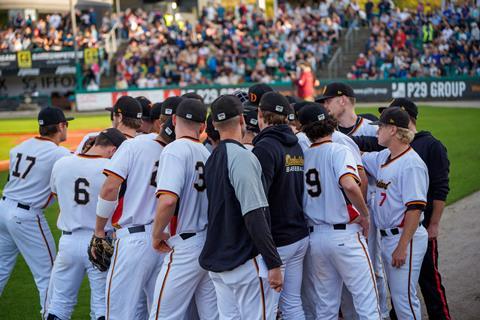
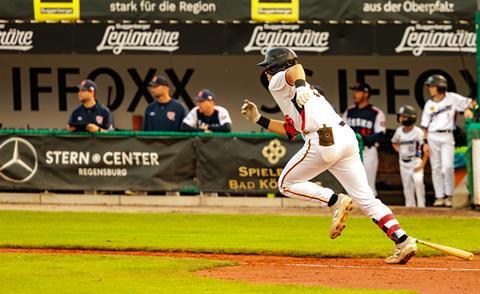
Increasingly, MLB’s eyes are on Germany. The domestic league has been rebranded as the Deutsche Baseball Liga (DBL), with a dedicated governing body and ambitions to establish baseball as the country’s “fourth major U.S. sport,” alongside American football, basketball and ice hockey. The change is proving effective. In its first year, the DBL has already seen a significant increase in public interest. Playoff games took place in front of record crowds. There is impact on social media as well. The final series alone received around 1.5 million views on Instagram.
However, this should be only the beginning. According to research from sports consultancy Sportheads, approximately 3.9 million Germans already identify as baseball fans – a substantial base that DBL Secretary General Markus Jaisle aims to cultivate through new television programming and live spectacles. His vision extends to hosting MLB regular-season games in Germany and potentially bringing the Savannah Bananas, an American entertainment troupe that blends baseball with theatrical showmanship, to German stadiums.
The Savannah Bananas, by the way, have built an $80 million baseball empire in just a few years. No Wall Street cash. No fancy ads. More or less just TikTok virality and a masterclass in knowing what the audience actually craves.
The digital retail opportunity in Europe
A critical economic lever for baseball lies in direct-to-consumer platforms. Major brands like Nike and New Balance already operate dedicated baseball web shops in the US, offering cleats, gloves and lifestyle apparel. These platforms are not yet available in Europe – but insiders suggest they could be rolled out quickly if market momentum continues. Combined with Fanatics’ omnichannel retail strategy, this digital expansion could open entirely new revenue streams in Germany and beyond, mirroring what has happened with basketball and American football in recent years.
Grassroots strength, Olympic momentum
Germany’s national teams provide a solid foundation. Youth squads have collected multiple European titles in recent years, with the U15 team winning the continental championship in 2025 to secure a World Cup berth. The men’s national team is now aiming to play a crucial role in the European Championship, which will take place this year on Sept. 20-27. The team is keeping in mind that the next edition, in 2027, will be held at home, in Regensburg and Munich. This tournament will also serve as a qualifier for the 2028 Los Angeles Olympics, where baseball will be back in the Games.
The Olympic comeback is expected to act as a catalyst: national federations will benefit from increased public funding, while brands can build campaigns and product lines around national-team exposure.

A sport in transformation
Baseball today is both big business and a cultural export. In North America it is a multi-billion-dollar industry, in Japan a thriving second market, and in Europe an experiment with clear growth potential. Germany in particular stands out as a test case for how quickly the sport can move beyond niche status.
For investors, sponsors and equipment makers, the opportunity lies between the mass market of licensed apparel and the high-margin world of customization and collectibles. If digital retail giants like Nike and New Balance activate their platforms in Europe, the market could accelerate rapidly.
And with Los Angeles 2028 on the horizon, baseball will once again be showcased on the world’s biggest sporting stage – a chance for the game to confirm its place not just as America’s pastime, but as a truly global industry.
Right now, anyone walking through the city center of a Western metropolis will sooner or later come across baseball. Even if neither the wearer nor the observer realizes it. The iconic “NY” logo of the New York Yankees on caps and shirts is already one of the best-selling sports merchandise items in the world. The Yankees benefit from their global brand awareness, which goes far beyond baseball. Some time ago, a study by Fanatics proved that the Bronx baseball team had become a cultural phenomenon.
Analysts examined the 300 most iconic rap songs in history and their music videos. The results were surprising: baseball equipment appeared in 58.8 percent of hip-hop videos, significantly more than gear from the NBA (22.8%) of the NFL (12.7%). The results are even clearer when it comes to headwear: 75.4 percent of all videos feature baseball caps, where the Yankees reign supreme.
Their caps appear in 27.5 percent of videos – nearly twice as often as the second-place Dodgers’ caps, which appear in 13.7 percent of videos. Hip-hop greats from Jay-Z to Nas have turned the intertwined “NY” logo into a lifestyle symbol. Jay-Z once rapped, “I made the Yankee hat more famous than a Yankee can.”
New Era, the manufacturer of MLB caps, owes much of its success to the rappers of the early 2000s. The connection goes deeper than fashion. For artists like Biggie, Method Man and the Beastie Boys, the Yankees embody the spirit of New York itself. One of the most vibrant cities of the world and birthplace of countless hip-hop talents has found the perfect symbol in its baseball team. An example of the potential that baseball and the lifestyle associated with it have in the sporting goods market.