Adidas delivered record sales in 2025 despite a difficult market, signaling that CEO Bjørn Gulden’s strategy is gaining traction. A shift toward a more decentralized “glocal” operating model, stronger cultural collaborations and the bridging of lifestyle and performance categories are now shaping the company’s next phase.
Adidas shows that the brand can grow even without Yeezy: The German sportswear company achieved record sales of €24.81 billion in 2025, even though it lost around €1.3 billion in sales after the end of the Yeezy partnership. New cultural collaborations – for example, with artists such as Bad Bunny – and strong demand for running and lifestyle products drove growth of the core Adidas brand.
On a currency-neutral basis, the brand grew by 13 percent. At the same time, the gross margin improved by 0.8 percentage points to 51.6 percent – a historically high level. Operating profit jumped 54 percent to €2.06 billion, while profit from continuing operations climbed nearly 70 percent to €1.38 billion. This increased the operating margin to 8.3 percent, up from 5.6 percent in the previous year.
| Adidas - Income (€ million) | |||
|---|---|---|---|
| 2025 | 2024 | Change | |
| Full year, ended Dec. 31 | |||
| Net sales | 24,811 | 23,683 | 4.8% |
| Cost of sales | 12,006 | 11,658 | 3.0% |
| Gross profit | 12,804 | 12,026 | 6.5% |
| Royalty and commission income | 81 | 81 | -0.2% |
| Other operating income | 41 | 174 | -76.6% |
| Other operating expenses | 10,871 | 10,945 | -0.7% |
| Operating profit | 2,056 | 1,337 | 53.8% |
| Financial income | 74 | 101 | -26.6% |
| Financial expenses | 310 | 317 | -2.0% |
| Pre-tax | 1,820 | 1,121 | 62.3% |
| Tax | 443 | 297 | 49.0% |
| Net income from continuing operations | 1,377 | 824 | 67.2% |
| Gain from discontinued operations, net of tax | 8 | 8 | 1.7% |
| Net income | 1,385 | 832 | 66.6% |
| Diluted EPS from continuing operations (€) | 7.46 | 4.24 | 76.2% |
| Diluted EPS from cont. and discont. ops. (€) | 7.51 | 4.28 | 75.4% |
| Fourth quarter, ended Dec. 31 | |||
| Net sales | 6,076 | 5,965 | 1.8% |
| Cost of sales | 2,988 | 2,995 | -0.2% |
| Gross profit | 3,088 | 2,970 | 4.0% |
| Royalty and commission income | 20 | 26 | -20.7% |
| Other operating income | 21 | 53 | -59.8% |
| Other operating expenses | 2,966 | 2,992 | -0.9% |
| Operating profit | 164 | 57 | 188.4% |
| Financial income | 20 | 30 | -34.4% |
| Financial expenses | 87 | 115 | -24.5% |
| Pre-tax | 96 | -29 | – |
| Tax | 12 | -2 | – |
| Net income from continuing operations | 85 | -27 | – |
| Gain from discontinued operations, net of tax | 6 | 7 | -16.1% |
| Net income | 91 | -20 | – |
| Diluted EPS from continuing operations (€) | 0.42 | -0.26 | – |
| Diluted EPS from cont. and discont. ops. (€) | 0.46 | -0.22 | – |
| Source: adidas AG press release, March 4, 2026 | |||
In addition, the company benefited from broad demand across all regions: Latin America grew by 22 percent on a currency-neutral basis, emerging markets by 17 percent and China by 13 percent, while Europe and North America each grew by around 10 percent. Adidas continues to generate most of its business with shoes. In 2025, the company reported sales of €14.23 billion in this segment, followed by apparel with €8.76 billion and accessories with €1.82 billion. This means that significantly more than half of the revenue is attributable to the shoe business, which remains the brand’s most important growth driver.
| Adidas - Net sales (€ million) | ||||||
|---|---|---|---|---|---|---|
| 2025 | 2024 | Change | Change (CN) | Brand adidas (CN) | ||
| Full year, ended Dec. 31 | ||||||
| Regions | ||||||
| Europe | 8,136 | 7,551 | 8% | 8% | 10% | |
| North America | 5,087 | 5,128 | -1% | 4% | 10% | |
| Greater China | 3,623 | 3,459 | 5% | 9% | 13% | |
| Emerging Markets | 3,510 | 3,310 | 6% | 15% | 17% | |
| Latin America | 2,926 | 2,772 | 6% | 21% | 22% | |
| Japan/South Korea | 1,406 | 1,339 | 5% | 11% | 14% | |
| Other Businesses | 72 | 93 | -22% | -22% | -22% | |
| Product divisions | ||||||
| Footwear | 14,232 | 13,977 | 2% | 7% | 12% | |
| Apparel | 8,764 | 7,937 | 10% | 15% | 15% | |
| Accessories | 1,815 | 1,779 | 2% | 6% | 6% | |
| Channels | ||||||
| Wholesale | 14,833 | 14,172 | 5% | 10% | 12% | |
| Direct-to-consumer (DTC) | 9,931 | 9,490 | 5% | 9% | 14% | |
| Own retail | – | – | 8% | 12% | 13% | |
| E-commerce | – | – | 1% | 6% | 16% | |
| Total | 24,811 | 23,683 | 5% | 10% | 13% | |
| Fourth quarter, ended Dec. 31 | ||||||
| Regions | ||||||
| Europe | 1,825 | 1,754 | 4% | 5% | 6% | |
| North America | 1,266 | 1,342 | -6% | 3% | 5% | |
| Greater China | 848 | 794 | 7% | 15% | 15% | |
| Emerging Markets | 943 | 940 | 0% | 15% | 15% | |
| Latin America | 835 | 807 | 3% | 18% | 18% | |
| Japan/South Korea | 319 | 318 | 0% | 13% | 13% | |
| Other Businesses | 16 | 19 | -18% | -15% | -15% | |
| Product divisions | ||||||
| Footwear | 3,245 | 3,391 | -4% | 4% | 5% | |
| Apparel | 2,384 | 2,126 | 12% | 20% | 20% | |
| Accessories | 447 | 448 | 0% | 7% | 7% | |
| Channels | ||||||
| Wholesale | 3,039 | 3,264 | -7% | 1% | 2% | |
| Direct-to-consumer (DTC) | 3,012 | 2,710 | 11% | 19% | 19% | |
| Own retail | – | – | 9% | 17% | 17% | |
| E-commerce | – | – | 13% | 22% | 21% | |
| Total | 6,076 | 5,965 | 2% | 10% | 11% | |
| Source: adidas AG press release, March 4, 2026 | ||||||
Adidas impacted by currency effects
However, external factors continued to weigh on business, as CEO Bjørn Gulden explicitly pointed out when presenting the results. In 2025, Adidas was significantly impacted by currency effects: the appreciation of the euro against several major currencies reduced sales by more than €1 billion. At the same time, higher US tariffs had a negative impact on profitability, even though the company was able to partially offset these burdens through lower product costs and a higher proportion of full-price sales. Adidas is not alone in facing these headwinds: Swiss competitor On Holding also recently reported that currency fluctuations and trade tensions are having a noticeable impact on its results (FY2025 earnings).
Some analysts are currently talking about a turnaround under Gulden. His contract was recently extended until 2030. Since taking office, the experienced manager – previously CEO of Puma – has focused primarily on strengthening the product pipeline and working more closely with retailers. At the same time, he reduced the company’s dependence on discount campaigns and placed greater emphasis on full-price sales. According to management, these measures have contributed significantly to the recent recovery in sales and margins.
Adidas’ transformation: from global control to local execution
Internally and culturally, Adidas is currently undergoing a transformation, and, to judge by the figures, appears to be making several strategic adjustments that are beginning to pay off.
A ‘glocal’ operating model
According to a long-time Adidas employee, almost all key decisions for global markets used to be made centrally at the company’s headquarters in Herzogenaurach. That approach often resulted in many ideas being rejected with a simple “no” or “that won’t work.” At the time, this reflected the prevailing industry mindset: trends emerging from the US were widely considered relevant for the entire world.
Today, however, consumer preferences are becoming far more fragmented. Members of Gen Z in Shanghai, Berlin or New York no longer necessarily share the same understanding of what is fashionable or culturally relevant. Adidas is gradually adapting its operating model to this reality.
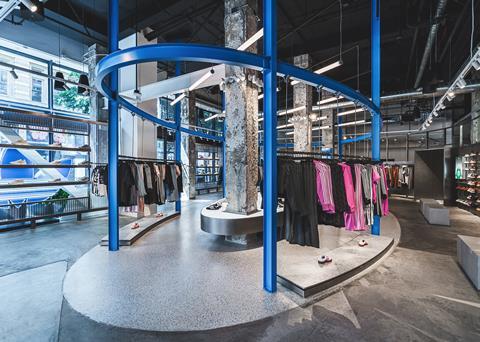
The company’s strategy can now be summarized as global branding with strong local adaptation. As Gulden puts it: “We have a global pipeline and local execution. We also believe that retail is local.” The shift is visible in many areas – from the different design concepts of flagship stores around the world to product initiatives such as a dedicated pet collection developed exclusively for the Chinese market. “Local teams will have more decision power,” Gulden said when describing the ongoing transformation.
Gulden sets his sights on the US
This decentralization also applies to the United States, which Gulden sees as a critical growth market. Adidas currently generates around €5 billion in annual sales in the US, representing roughly 10 percent growth. The company’s long-term ambition is to double that figure to €10 billion.
Gulden is aware that this will take time. A key part of the strategy involves strengthening Adidas’ presence in high school and college sports to increase brand visibility. That requires signing more partnerships with school teams – a process that cannot happen overnight.
However, Gulden believes the brand’s credibility in the US market is already improving. Successful collaborations with cultural figures and designers have helped to build momentum. Examples include Pharrell Williams’ Adistar Jellyfish project as well as partnerships with Bad Bunny, Arte Antwerp and Willy Chavarria.
Bridging lifestyle and performance
In the lifestyle segment, Adidas recently benefited from the Terrace models. According to Gulden, demand for Terrace turned out to be “larger than expected,” which reduced the immediate need to revive classics such as the Superstar. The company is now preparing the next step by bringing renewed attention to the Stan Smith this year.
In apparel, Adidas is increasingly focusing on court- and college-inspired looks, using a broader mix of materials, such as knitwear and denim, to strengthen the crossover between sport and fashion.
At the same time, the company continues to concentrate its performance strategy on four global pillars: running, football, training and basketball – the last particularly because of its cultural relevance.
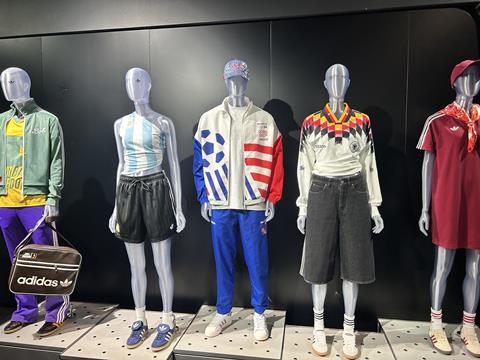
Across all four categories, Adidas is increasingly trying to bridge the gap between performance and lifestyle. In football, this includes street-ready versions of iconic boots such as the Predator and F50. In the fast-growing running category, which expanded by 29 percent, Adidas plans to launch the Hyperboost in the coming months, combining running performance with lifestyle appeal and everyday comfort.
The same philosophy applies to the training segment, where many new products will deliberately combine functional performance with fashion elements. For women’s styles in particular, Adidas is increasingly using its Originals sub-brand rather than relying solely on external collaborations.
Nervous stock market reactions
Despite this operational progress, the stock markets reacted nervously: Adidas shares came under pressure after the figures were published. Investors were particularly disappointed by the cautious forecast for 2026. The company expects sales growth in the high single-digit percentage range, which would correspond to an increase of around €2 billion. At the same time, management expects operating profit of around €2.3 billion. However, higher US tariffs and unfavorable currency effects could reduce operating profit by around €400 million. For many investors, the outlook was therefore less dynamic than hoped for – a classic case of strong results but subdued expectations for the next fiscal year.
And there is something else that may have heightened analysts’ concerns: a possible slowdown in the global sneaker boom and increased competition. In January, Bank of America stated that growth is likely to normalize after the expected surge in demand triggered by the 2026 World Cup. At the same time, competitors such as On and Asics would gain market share with sustained double-digit growth rates and increasingly attract investor attention. The message from the markets to Adidas is therefore clear: the turnaround is visible – but investors now want to see more momentum before they are willing to revalue the stock.