The world’s largest contract footwear manufacturer reported weaker results in 2025. Stable manufacturing was offset by weaker sales in China at its Greater China retail subsidiary. Management nevertheless remains cautiously optimistic for 2026, citing the continued athleisure trend and major sporting events as potential demand drivers.
Manufacturing stable, retail weak: Yue Yuen Industrial (Holdings) reported a slight decline in sales and profits for the 2025 financial year. Sales fell by 1.8 percent to $8.03 billion, while net profit declined by 2.9 percent to $381.1 million. The result was primarily impacted by the weak consumer climate in the Chinese sporting goods trade, which put pressure on the retail subsidiary Pou Sheng. At the same time, more cautious orders from brand partners as well as higher labor costs and start-up costs for new production capacities put additional pressure on margins: The gross margin fell by 1.6 percentage points to 22.8 percent for the year as a whole.
| Yue Yuen Industrial (Holdings) Limited – Income | |||
|---|---|---|---|
| Full year, ended Dec. 31 ($ thousand) | |||
| 2025 | 2024 | Change | |
| Revenue | 8,031,354 | 8,182,161 | -1.8% |
| Cost of sales | 6,203,550 | 6,189,451 | 0.2% |
| Gross profit | 1,827,804 | 1,992,710 | -8.3% |
| Other income | 107,012 | 122,713 | -12.8% |
| Selling and distribution expenses | 780,541 | 838,163 | -6.9% |
| Administrative expenses | 562,215 | 553,395 | 1.6% |
| Other expenses | 156,173 | 177,427 | -12.0% |
| Finance costs | 53,166 | 63,339 | -16.1% |
| Other gains and losses | 13,211 | 10,565 | 25.0% |
| Pre-tax | 465,825 | 572,097 | -18.6% |
| Tax | 70,429 | 147,444 | -52.2% |
| Profit | 395,396 | 424,653 | -6.9% |
| Diluted EPS (US cents) | 23.75 | 24.34 | -2.4% |
| Source: Yue Yuen Industrial (Holdings) Limited | |||
Athletic and outdoor shoes led sales
Good news comes from contract manufacturing, which remained stable in fiscal 2025. Sales in the manufacturing segment rose slightly by 0.5 percent to $5.65 billion. Athletic and outdoor shoes remained the largest product category with revenue of $4.44 billion.
Shipment volumes nevertheless declined slightly to 252.2 million pairs, as brands were more cautious in their ordering in the second half of the year, according to management. At the same time, the average selling price increased by 3.7 percent to $21.00 per pair, helping to cushion the slight decline in volume.
| Yue Yuen Industrial (Holdings) Limited — Revenues | ||||
|---|---|---|---|---|
| Full year, ended Dec. 31 ($ thousand) | ||||
| 2025 | 2024 | Change | ||
| Products | ||||
| Athletic/Outdoor Shoes | 4,435,037 | 4,403,600 | 0.7% | |
| Casual Shoes & Sports Sandals | 861,601 | 765,388 | 12.6% | |
| Soles, Components & Others | 351,646 | 451,765 | -22.2% | |
| Pou Sheng (retail) | 2,383,070 | 2,561,408 | -7.0% | |
| Total | 8,031,354 | 8,182,161 | -1.8% | |
| Regions | ||||
| United States | 1,605,310 | 1,542,031 | 4.1% | |
| Europe | 1,531,024 | 1,429,624 | 7.1% | |
| PRC | 3,133,605 | 3,580,267 | -12.5% | |
| Other Asia | 1,208,132 | 1,174,519 | 2.9% | |
| Others | 553,283 | 455,720 | 21.4% | |
| Total | 8,031,354 | 8,182,161 | -1.8% | |
| Source: Yue Yuen Industrial (Holdings) Limited | ||||
Yue Yuen benefits from the athleisure trend
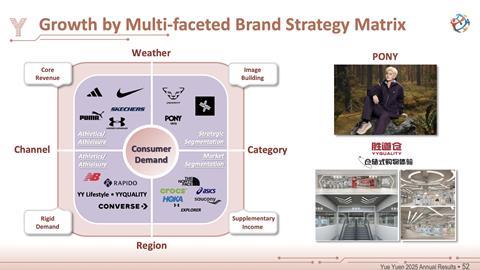
The increase in casual shoes and sports sandals was particularly striking. Sales in this category jumped by 12.6 percent to $861.6 million. This suggests that the world’s largest shoe manufacturer continues to benefit from the athleisure trend and that more and more sports brands are jumping on the bandwagon. A good example of this is Asics. The Japanese group is now no longer only successful with its performance running shoes, but is also expanding the production of its lifestyle models internationally. Adidas and Nike also continue to focus strongly on these segments.
Over 20 percent less: Components business under pressure
In contrast, Yue Yuen’s Soles, Components & Others division was a clear outlier. Sales fell by 22.2 percent year-on-year to $351.7 million. Experts attribute this to weaker global demand for shoes and the reduction of high inventories at brands and retailers. Components such as soles, midsoles, and other shoe parts are ordered early in the production process. When brands reduce their production plans, demand for these intermediate products is the first to decline. Industry observers see this as a possible early warning sign for the industry.
Weak sporting goods trade in China
Pou Sheng also saw a decline. Sales at the retail subsidiary in Greater China fell by 7 percent to $2.38 billion in 2025. Among other things, the group cites the current weak consumer climate in China as one of the reasons for this. Multibrand retailers such as Pou Sheng are under particular pressure. High inventory levels in the market are also leading to aggressive discount campaigns. This weighed on sales in its own stores as well as in its distributor business. Even though digital channels performed solidly, they were only able to partially offset the decline in brick-and-mortar retail. Pou Sheng closed a net total of 138 stores during the year, ending the year with 3,310 stores.
Global production shift: Southeast Asia gains ground
Yue Yuen is following the trend in the footwear industry of shifting production more heavily to Southeast Asia. This is also indicated by the export figures cited by the company in its annual report: while China’s footwear exports fell by 11.3 percent in 2025, they rose by 5.8 percent in Vietnam and 9.5 percent in Indonesia.
The shift is also reflected in Yue Yuen’s own production footprint. Indonesia accounted for 54 percent of the group’s shoe production in 2025, followed by Vietnam with 32 percent, while other locations in South and Southeast Asia such as Bangladesh are gaining importance.
Multi-million investment: New factory in India
A new factory belonging to the group began operations in Central Java, Indonesia, in 2025. Yue Yuen is also investing around $276 million in a new factory in the Indian state of Tamil Nadu, which will be built in several phases. The project is intended to expand production capacity, diversify the geographical footprint, and further reduce dependence on China.
Cautious outlook for 2026
Although the guidance for 2026 is more cautious than the outlook in the nine-month report, management remains confident. The ongoing athleisure trend and major sporting events such as the 2026 World Cup in North America (June 11 to July 19) and the Asian Games in Japan in fall 2026 could support demand for sporting goods. With new production sites and a broader supply chain, Yue Yuen believes it is well positioned to benefit from the long-term growth of the industry.