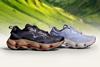
The global running market is experiencing a shift in the balance of power: while the top dogs fight for their position, challengers are gaining ground with speed and a keen sense of trends. Our analysis combines financial figures with brand strategies and shows why performance alone is no longer enough: if you want to be at the forefront in the future, you must also conquer the streets of Tokyo, New York and Paris.
Explore the market: click for each category
Running purists versus multisport giants
Nike and Adidas: One market, two paths
Puma, Skechers and New Balance in the slipstream
Strong performance: On and Hoka are growing rapidly
Asics, Brooks and Co.: The specialists remain in the race
Performance + lifestyle = success
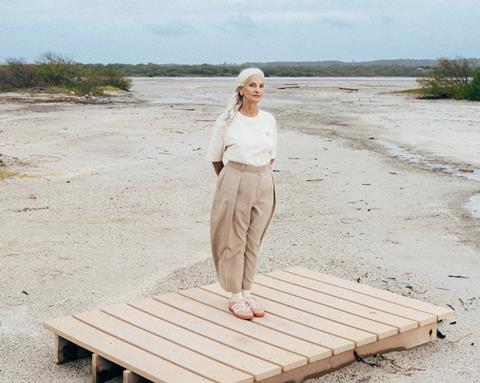
Shoes are at the heart of the sporting goods business – but running does not play a role everywhere that billions in sales are reported. For big names like Nike, Adidas and Puma, soccer shoes, team sports and lifestyle icons appear on the balance sheet just as much as high-performance running shoes. At Adidas, it’s not just the retro hits Samba and Gazelle that are driving sales, but also soccer classics like the Predator. Nike, on the other hand, thrives on all-time favorites like the Air Force 1. While running is a focus for the footwear giant, it only accounts for a portion of total volume. And Puma expressly emphasizes that team sports and running are the key drivers – with football a traditional pillar.
Running purists versus multisport giants
The picture is very different for the challengers and specialists: On, Hoka, Brooks, Mizuno, Saucony and Asics generate the majority of their sales with running shoes – for them, performance is the core of their business. Salomon is also benefiting from the boom in trail running, but is simultaneously expanding its lifestyle business: around 35 percent of its footwear sales are already attributable to sports style. Under Armour lies somewhere in between – with footwear sales of over a billion dollars, in which running, according to the company, is only a sub-segment alongside basketball, training and football. But if you want to understand the market, you need to know the differences between the top dogs and the challengers. That’s why SGI Europe has taken a closer look for you: at the big two, the pursuers, the growth wonders – and the specialists with decades of running DNA.
Nike and Adidas: One market, two paths
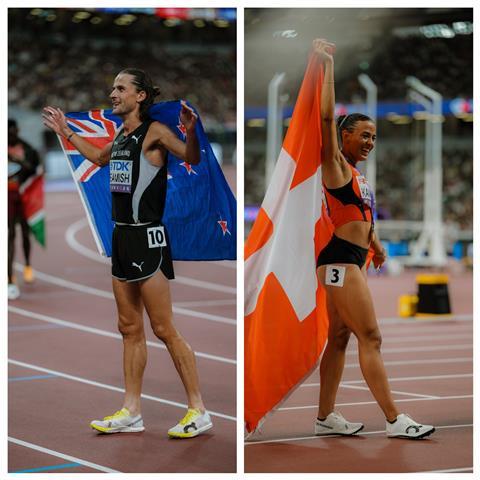
The big two dominate the market, but their paths could hardly be more different. Nike remains number one, with shoe sales of $29.51 billion, but has suffered a significant decline in the past fiscal year. This is a warning sign that consumer restraint and competitive pressure can also affect the industry leader. Even core categories such as running, which Nike regularly highlights as strategically crucial in analyst calls, are not exempt. Adidas, on the other hand, has recorded a noticeable upturn, with €13.98 billion in sales in the footwear division. In addition to retro trends with models such as Samba and Gazelle, the Adizero running shoe family played a role. The company has transferred its credibility to new models, such as Ultraboost 5, Supernova and Adistar. The two heavyweights show that shoes remain the backbone of the industry. However, Adidas is currently benefiting mainly from trends, while Nike is struggling to regain its former strength.
- Nike: Footwear sales of $33.43 billion (2024) to $29.51 billion (2025)
Share of total sales: approx. 66 percent
Growth: -12 percent - Adidas: Footwear sales of €12.08 billion (2023) to €13.98 billion (2024)
Share of total sales: approx. 59 percent
Growth: +16 percent
Puma, Skechers and New Balance in the slipstream
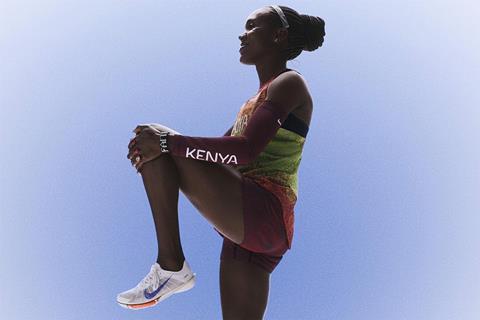
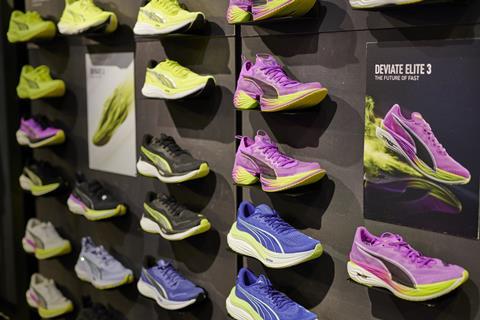
The two industry giants’ pursuers are also holding their own. Puma consolidated its position last year with solid results: the German brand generated €4.73 billion in footwear sales in 2024, with team sports and running being clear growth drivers. Skechers impresses with its sheer size – with total sales of almost $9 billion, the US company is number three worldwide, behind Nike and Adidas. But running is only part of the picture. According to expert estimates, the category contributes around $1 to $1.7 billion to the business. New Balance, in turn, recorded sales growth of around 20 percent in 2024 to an estimated $7.8 billion. The privately owned brand combines lifestyle icons, such as the 550 and 990, with performance models, such as the FuelCell series – striking a balance between fashion and high performance.
- Puma: Footwear sales of €4.58 billion (2023) to €4.73 billion (2024)
Share of total sales: approx. 53.7 percent
Growth: +3.3 percent - Skechers: Total sales of $8 billion (2023) to $8.97 billion (2024)
Footwear share: approx. 70 to 80 percent
Growth: +12.1 percent - New Balance: Total sales of approx. $6.5 billion (2023) to approx. $7.8 billion (2024)
Running & Lifestyle as equal growth drivers
Growth: estimated +20 percent
Strong performance: On and Hoka are growing rapidly
While the heavyweights are focusing on stability, the challengers are making an impression with their speed. With double-digit growth and new successful models, they are capturing market share and shifting the balance of power in the footwear segment. On Holding increased its sales to CHF 2.3 billion (€2.19bn) in 2024, with shoes accounting for over 94 percent of this figure. This represents an increase of 28.5 percent, driven by innovations such as the Cloudmonster 2 and strong direct sales. Hoka, part of Deckers Brands, also remains a growth miracle: the brand achieved sales of $2.2 billion in fiscal year 2025, almost exclusively with running shoes, and grew by 24 percent. Salomon, the outdoor icon from the Alps, broke the $1 billion mark in the footwear segment for the first time in 2024, according to company figures, driven in particular by the boom in sports style and trail running. Under Armour, which has recently been in reverse gear, reported a slight increase: sales in the footwear segment rose to $1.4 billion, which corresponds to around 27 percent of total sales.
- On: Footwear sales of CHF 2.2 billion (€2.09bn, 2023) to CHF 2.3 billion (€2.19bn, 2024)
Share of total sales: approx. 94 percent
Growth: +28.5 percent - Hoka (Deckers Brands): Footwear sales of $1.8 billion (2024) to $2.2 billion (2025)
Share of total sales: approx. 100 percent
Growth: +24 percent - Salomon (Amer Sports): Footwear sales of just under $1.0 billion (2023) to over $1.0 billion (2024)
Share of total sales: not reported separately (sport style = 35% of shoes)
Growth: double-digit growth - Under Armour: Footwear sales of $1.35 billion (2024) to $1.4 billion (2025)
Share of total sales: approx. 27 percent
Growth: +4 percent
Asics, Brooks and Co.: The specialists remain in the race
Apart from the major players, there is a group that has been shaping the running shoe market for decades: established specialists that may be smaller but score points with their strong running DNA and high credibility. Asics remains the most important player here: in 2024, the Japanese brand generated ¥378.6 billion (€2.36bn) in the footwear segment – around 83 percent of its total business. With classics such as Gel-Kayano and Gel-Nimbus, Asics dominates many running communities. Brooks Running, a subsidiary of Berkshire Hathaway, achieved sales of $1.4 billion in 2024, almost exclusively with running shoes, for an increase of 14 percent. The US brand is considered the number one in American performance running and is growing strongly internationally. Saucony, part of Wolverine Worldwide, also ranks in the middle of the pack, with sales of $525 million, but is making headlines with innovative series such as Endorphin. The US brand is considered an insider tip among ambitious runners. Mizuno achieved shoe sales of ¥80.5 billion (€503m) in the same year, an increase of 6 percent, driven by Wave technology and strong demand in Asia and Europe.
- Asics: Footwear sales of ¥357.0 billion (€2.23bn, 2023) to ¥378.6 billion (€2.36bn, 2024)
Share of total sales: approx. 83 percent
Growth: +6 percent - Brooks: Footwear sales of $1.23 billion (2023) to $1.4 billion (2024)
Share of total sales: approx. 100 percent
Growth: +14 percent - Saucony (Wolverine Worldwide): Footwear sales of $496 million (2023) to $525 million (2024)
Share of total sales: not reported separately, nearly 100 percent
Growth: +6 percent - Mizuno: Footwear sales of ¥75.9 billion (€472m, 2023) to ¥80.5 billion (€503m, 2024)
Share of total sales: approx. 36 percent
Growth: +6 percent

Performance + lifestyle = success
Our analysis shows that running brands succeed when they think beyond sport. Asics, for example, is building on its strong performance DNA, with lifestyle collections such as Tokyo and New York, which have long appealed to non-athletes as well. On, meanwhile, combines technological innovation with fashion collaborations and has thus evolved from a pure running shoe supplier to an urban lifestyle brand. Adidas shows how both can go together – retro hits such as Samba and Gazelle meet the trends, while performance lines such as Adizero secure the athletic foundation. And Salomon is using its trail running boom to break into the street fashion market with sporty sneakers. The way forward in the running shoe market is down the straight road – not a winding trail: the brands that perform best are those that credibly combine performance and lifestyle. This allows them to reach not only athletes, but also a new generation of consumer.