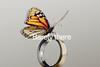
Oura’s 2026 moves – hardware, gesture AI, governing body deals, GLP-1 integration – add up to something the wearables market hasn’t seen before: a coherent platform thesis.
On June 4, on a side street in SoHo, a man known as Moses the Jeweler will hold a coin in the air. Those who call it right keep the prize: a ring roughly the size of a wedding band, made of titanium, packed with cardiovascular sensors. The event is a one-day pawn shop experience conceived by ad agency nice&frank to launch Oura’s new Ring 5: brief, theatrical, and almost absurd. It is also, in miniature, a portrait of how a Finnish health tech company worth $10.9 billion has decided to communicate to the world in 2026.
Moses the Jeweler, a fixture of New York’s Diamond District and a jewelry influencer (real name: Moses Zeira, owner of Moses NYC), hosts the flip, and winners walk out with a Ring 5.
Visualizza questo post su Instagram
The pawn shop is part of the ”Subtle Power” campaign, which the brand describes as the largest media campaign in its history. The concept turns the product’s chief attribute into its selling argument: the new smart ring is 40 percent smaller than its predecessor, and the campaign asks why that should feel like less. Placements are planned across major live sports broadcasts and streaming platforms, with out-of-home advertising in 15 US cities. The campaign runs through the summer and into the US Open in September.
The machine inside the ring
“Subtle Power” is, first and foremost, a product launch campaign: Ring 5’s small size is the outcome of an engineering effort that, according to the company, took years and required Oura’s industrial design team to confront what they describe internally as a domino effect: change one component and every other must follow.
The finger, rather than the wrist, has always been Oura’s central technical argument. The company maintains that finger-based sensing provides stronger biometric signals than wrist-based devices: a claim it grounds in the density of blood vessels close to the skin’s surface. That advantage, whether or not it meets the bar of clinical consensus, has been sufficient to allow Oura to extend from sleep tracking into stress, recovery and women’s health without acquiring new hardware categories.
The campaign starts with an event, but it expands online, showing the ring across different moments, on the fingers of all types of people: not athletes, but artists, teachers, artisans and orchestra directors.
Soft sell, long game
Beyond the product launch messaging, “Subtle Power” is also a statement of brand philosophy. Oura has not historically positioned around performance culture. Its marketing did not feature elite athletes in extremis. The earlier ”Give Us the Finger” campaign, which built the brand’s consumer awareness, was provocative in form and quiet in register: the ring, it argued, speaks for itself precisely because it says nothing.
The new campaign deepens that logic into a character-driven format. The films are designed to show technology operating invisibly: in a classroom, an orchestra, a fingertip. The metamessage: a wearable is not just a device; it is an expression of the person wearing it. Better if it is silent, less visible, sober.
The design philosophy that underlies this is very Nordic, and Oura applies it consistently: the ring uses no haptic alerts or screen notifications, a choice that distinguishes it from almost every other wearable on the market.
Building the stack
The most strategically consequential move of Oura’s recent period may be one that attracted less consumer attention: the acquisition, in early 2026, of Doublepoint, a Finnish gesture-recognition software startup. Doublepoint’s technology interprets signals from standard wearable sensors to detect small hand and finger movements: taps, pinches, rotations.
The software roadmap announced alongside Ring 5 adds further layers. Health Radar, due to begin rolling out in June 2026 to members in the US, the UAE and India, introduces continuous cardiovascular and respiratory monitoring. A GLP-1 Insights feature, also launching in June for the same initial markets, consolidates dosing, biometric and lifestyle data into a single longitudinal view for users on weight-loss medications. Live Activity Tracking, which brings real-time workout metrics to the ring for the first time, begins global rollout on June 4.
Also on June 4: a device-location tool called Locate, and a selective data-deletion feature that allows members to remove health data from a specific time window without closing their accounts. That last detail is worth noting. In a category under growing scrutiny over health data governance, Oura is making granular user control a visible product feature. Transparency first.
What the numbers say
Oura’s commercial trajectory has been steep. Annual revenues exceeded $500 million in 2024 and were projected to reach $1 billion in 2025, according to figures reported around the company’s October 2025 Series E round, which raised $875 million and lifted the valuation to approximately $10.9 billion.
The ring is sold across more than 150 countries through approximately 4,000 points of sale in 20 markets, according to company data.
Europe is part of the growth story, not just the origin story. The “Subtle Power” campaign rolls out across nine markets, with out-of-home placements confirmed in Berlin and London alongside US cities including New York, Los Angeles, DC and Boston, according to The Drum.
The inclusion of two European cities in the flagship OOH push is a small but significant signal: Oura is investing in consumer awareness on a continent where its brand recognition still trails its North American foothold – and where the governing body partnership strategy has, so far, been built entirely around US federations.
The question the ring still has to answer: the transformative power of a smart ring
None of this resolves the most fundamental question the wearables category faces: whether continuous biometric monitoring, at the level of granularity Oura now provides, changes health behavior at population scale – and more than the wearables market has managed in the last ten years, by going beyond the performance-obsessed, the outdoor athletes, the sports practitioners, to become part of a normal active, mindful lifestyle. It is a question that a pawn shop in SoHo, however brilliant (literally) the staging, cannot answer.