Your sponsored athlete has missed their goal? What now? Disaster for the brand? It could actually be the opposite.
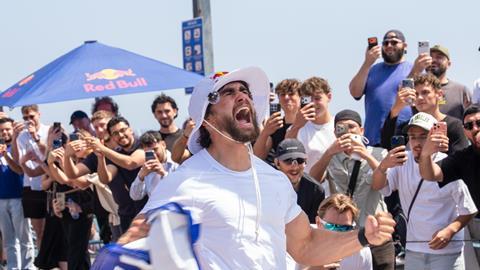
Ultrarunner and “hybrid athlete” Arda Saatçi recently completed a gruelling multiday run across California, beginning in the heat of death valley and ending up in Santa Monica, running the equivalent of 14 marathons in 4 days. But there’s just one catch: Saatçi didn’t actually complete the challenge as intended – running 600km in under 96 hours.
Instead, Saatçi’s superhuman efforts overran the allotted time. At the end of the 96 hours he had managed around 458 km. But the German-born endurance star continued, as did the live stream on YouTube, Twitch and Red Bull TV, and his determination garnered even more attention. Saatçi ran in Brooks Running shoes — the brand has been his exclusive footwear partner since September 2025 — while Red Bull served as his main sponsor and media platform.
By the end of his challenge, his 120-plus hour livestream had almost 59 million viewers watching and willing him across the line. If anything, his “failure” meant more to his fans than had he succeeded in beating his original target time. A post at the end of the original 96 hours has 309,000 likes; a post of Saatçi crossing the finish line later than planned has 1.3 million likes. It may sound like spin, but the press release from Saatçi’s main sponsors Red Bull says it all: “The original target of 96 hours faded into the background – what truly mattered was an extraordinary performance that moved people.”
There is a well-known adage that, “The world loves a trier.” Britain’s Eddie-“the Eagle”-Edwards captured hearts in the 80s whilst finishing last in the 70m and 90m ski jumping events at the 1988 Winter Olympics. That same year also saw the original Jamaican bobsleigh team take to the track. Movies and sponsorships followed and the (sub-)performances entered into Millenial lore.
Gen-Z has a complex relationship with failure. At a personal level, their own (low stakes) failures in the workplace or in social situations risk being given the devastating label of “cringe.” But in their search for authenticity, stories which include vulnerability are hitting the mark and garnering a following.
When ‘failure’ goes wrong
When it comes to the public, the difference between a successful failure and a failed failure is how it is told. Crucially, what matters to the public is openness. Like with Saatçi, there can be no glossing over of an athlete missing their target.
In July 2025, climbers Dani Arnold, Alexander Huber and Simon Geitl announced they had achieved a first ascent of a new line on Peru’s Jirishanca mountain. naming and grading their new route Kolibri (5.12). The original social media post declared, “Luck was on our side in every respect, we were able to take advantage of the weather window and realize our projects!”
However, questions were soon raised by the group’s use of the term “East Summit” to describe their high point and end of the climb. Alpinists and journalists agreed, there is no “East Summit” on Jirishanca; the team’s high point is a ridge before the actual summit.
In a Climbing.com article questioning the details of the new route and the framing of the team’s accomplishment, Arnold admitted that the “true summit” had been the original goal, but weather conditions had created extremely dangerous conditions.
One month later, the team issued a clarification of their use of “East Summit” via a new social media post which essentially admitted the trio had missed their original target: “Naturally, we would have loved to climb to the summit of Jirishanca,” it said. But by originally framing their “almost” as a success, they ultimately overshadowed what was a very impressive technical and demanding feat.
Discussion around the controversy did also raise the question of whether sponsorship pressure had led to the exaggeration of what had been achieved by Arnold, Huber, and Geitl.
When ‘failure’ is done right
There can be no bigger platform for “owning” a failure than that of the GOAT, Simone Biles.
At the Tokyo 2020 Olympics (held in 2021), Biles was tipped to win at least four of the six gold medals up for grabs. Instead, she won the hearts of many when she “chose herself” over the competition after suffering a bout of the twisties – a phenomenon whereby athletes can lose a sense of where they are in the air and relation to the floor, which could lead to dangerous landings or missed landings and serious injury.
In a precursor to her Olympic withdrawal, Biles had switched sponsors from Nike to Athleta, saying of her new sponsors in the Wall Street Journal: “I felt like it wasn’t just about my achievements, it’s what I stood for and how they were going to help me use my voice and also be a voice for females and kids.” It may not have mattered to Biles at all, but having a sponsor be OK with an athlete’s decision to quit an important event could have been a supportive pillar in her decision not to compete.
In the end, Biles achieved a near-Hollywood ending. At her return to the Olympics in Paris 2024, she won four more medals, including three golds. She is now the most decorated gymnast in the history of the Olympics and World Championships.
Failure no longer cringe
In 2021, Biles’ decision was polarising. Some criticised her for dropping out, whilst others praised her openness and defiance in choosing herself amidst such weighty expectations. But in just a few years, it seems that failure – for the right reasons and done the right way – is less of a contentious issue and more something to be admired. Few figures tread the line between success and failure, and appeal to the average population, as well as today’s endurance athletes. Successful figures – like Saatçi – can garner millions of followers online. An audience that is appealing to sponsors.
Russ Cook (aka @hardestgeezer) doesn’t look like the traditional athlete, with his long red beard and bucket hat, but he has completed a series of incredible physical feats. To date Cook has 1.1 million followers on Instagram, with posts frequently gathering a minimum of 400,000 views. And he makes clear that there can be no trying without failing.
Although Cook did complete his 2023 goal of running the length of Africa (352 days; 386 marathons), the near-miss moments where it looked like he might fail – and his attitude towards that failure – drew people in. Cook was robbed at gunpoint in Angola and went missing for days in the DRC. A back injury looked set to end his attempt after 200 days, but Cook took a two day rest and carried on.
Cook is a Hoka athlete, wearing their shoes and hat throughout and has since agreed a sponsorship with 247 athlete wear.
It wasn’t a marketing pitch, but Cook’s advice to graduates as he accepted an honorary degree from the University of Chichester in April 2026 could also have applied to athlete-sponsor relationships: “Don’t be scared to fail. Attack life with passion!”
Finally, a personal note from Valentina, SGI Europe’s Editor-in-Chief.
Long before joining this title, I had the honor of being part of the early years of Red Bull Media House, during its transformation from a communications tool into a media and publishing powerhouse, as its Global Head of Digital Channels. And on what it means to embrace failure and build truly grand storytelling around it, I have something to share:
For brands supporting athletes in extreme adventures, the question of how to handle a failure – or a performance that falls short of its target – has always been a communications challenge. Even Red Bull had to learn that the hard way.
When I joined Red Bull Media House in 2011 to guide its digital content strategy, I was not ready myself to deal with Plan B scenarios. At the time, there were none. Nor was anyone prepared to communicate an athlete’s death. We were, both the storytellers at the Media House and the communication managers, afraid to release “bad news” – to the point that, I can say now, there were moments when we were asked to take down stories dealing with death, failed achievements, missed goals.
The answer came from going back to first principles – 2,500 years back, to when storytelling as we know it was first shaped. From the old Greek epos, through the biblical narratives, to the landmark framework Joseph Campbell set out in his study of the most fundamental storytelling pattern we share: the hero’s journey.
We sat together – video makers, scriptwriters, communication and brand managers – in a series of sessions we half-jokingly called storytelling self-therapy, and worked through what that meant for us. What emerged became the defining mark of Red Bull’s approach to athlete stories: the hero’s journey, as told from ancient epos to the cinema of our time, has nothing to do with arriving first or winning a battle. It is about receiving a call, undertaking a journey into the unknown – which is precisely what extreme endurance and adventure sport is about – and coming back transformed.
In Campbell’s framework, the hero on the journey meets a mentor: someone who helps to solve enigmas, find the right path, and sometimes recognize when it is better to change direction, or turn back. That became our answer. With our brand storytelling, we decided to become the mentor, not the sponsor, and to focus on the human development of the athletes we supported. We solved the dilemma of how to recount a missed goal in the most radical way: by celebrating the human effort, not the record.
That is why Red Bull became the most significant brand storyteller in the history of sports marketing. And that is why a story like Arda Saatçi’s stops the scroll and leaves you inspired rather than deflated. Brands that choose to act as mentors will benefit from that choice – independently of whether the final line is crossed, the record broken, or the summit reached.”
Hero image: Red Bull Content Pool for editorial use