Kit customization runs on pre-loaded letter inventory set before a ball is kicked. Germany’s 7-1 opener produced three V-name scorers in 72 hours, draining online stock and exposing the limits of forecast-driven merch supply in the final adidas-Germany cycle.
The most unexpected supply crisis of the 2026 World Cup has nothing to do with footballs, stadium capacity, or broadcast rights. It involves a single letter of the alphabet.
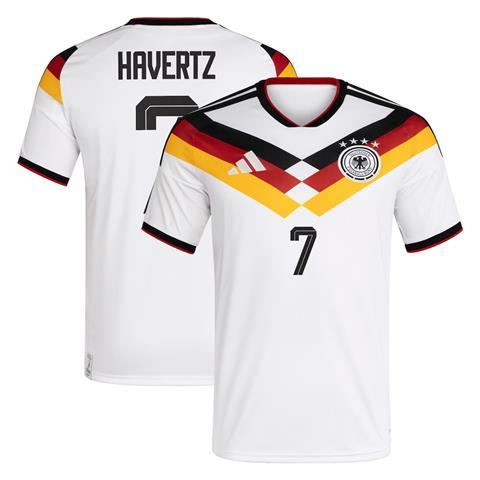
adidas confirmed Wednesday to AFP that it had temporarily run out of the letter V for customizing Germany replica kits. The shortage was triggered by demand for shirts bearing the surnames of strikers Kai Havertz and Deniz Undav — both scorers in Germany’s 7–1 opening win over Curaçao on June 15 — and midfielder Aleksandar Pavlovic, whose name alone requires two Vs. All three shirts were briefly unavailable to order online but were back by end of day.
What a letter shortage actually tells you about merch demand
Kit customization operates on a physical letter inventory that manufacturers must pre-load before a tournament. The system assumes a statistical distribution of which names fans will want — and demand spikes driven by tournament performance can break those assumptions fast.
Germany’s opening game produced three players with V-containing surnames who each scored or created directly; that combination compressed weeks of expected demand into 72 hours.
Footy Headlines reported a practical asymmetry in how the shortage played out: adidas’s flagship store in Berlin had pre-ordered sufficient letter stock for all characters before the tournament and could process customized shirts with a few days’ turnaround, while the online channel — which operates from a single central inventory — ran dry. For adidas, the gap between physical and digital fulfillment under real-time demand is a supply planning problem, not a production one.
The last World Cup for adidas and Germany
Germany’s 2026 kits are proving unusually popular by any measure. The white home shirt, which echoes the black, red and gold stripes of Germany’s Italia ’90 strip — the tournament that ended in the country’s third World Cup title — is selling strongly. The turquoise second strip is, according to DW, outperforming even the home kit.
adidas supplies kits for 14 of the 48 teams at this year’s tournament, and the Germany deal is among its most commercially significant. It is also the last: the German Football Federation (DFB) has confirmed it will switch its kit contract to Nike from 2027, ending a partnership spanning more than 70 years and four World Cup titles.
Part of what is driving that demand is anticipatory: fans who know this is adidas’s final Germany cycle are purchasing with a finality that routine tournament demand does not typically generate. It is nostalgia acting in the present tense.
This success has a recent precedent. adidas’s pink away shirt from the 2024 European Championships remains the best-selling Germany away kit of all time — proof that the appetite for Germany replica kits, in the right design, runs well ahead of expectation.
Whether the letter V shortage turns out to be a supply planning footnote or the most cost-effective piece of earned media adidas has generated at this tournament is a question the brand’s licensing team will be answering long after the final whistle.
FIFA World Cup 2026: The Business of the Beautiful Game
How brands, retailers, and the sports economy compete on football’s biggest stage.
Explore Our Coverage →