Retailer, brand owner, manufacturer, sales partner, licensee - the business areas of Cologne-based streetwear retailer Snipes are manifold. Dennis Schröder, who has just taken over the helm from company founder Sven Voth, explains what’s next for Snipes and what makes the company so successful.
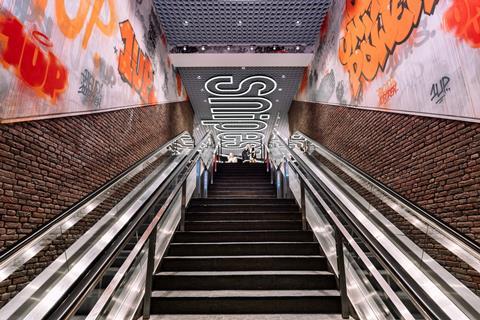
The Transition to New Leadership at Snipes
In January this year, Dennis Schröder took over the management of Cologne-based sneaker and streetwear retailer Snipes from Sven Voth, who founded the company 25 years ago in Essen. Voth had originally planned to stay with the company for another two years, but a few weeks ago, it was announced that he would be handing over the reins to his successor Schröder earlier – in fact, with immediate effect.
Dennis Schröder’s Background and Vision
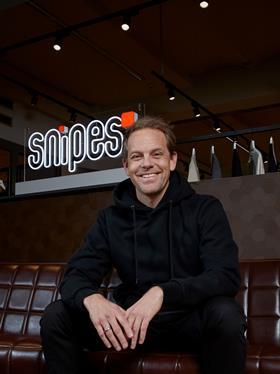
Schröder, who joined Snipes a year ago as General Manager EMEA and previously held management positions at 11 Teamsports, Nike and Puma, has big shoes to fill. Not only because Voth has managed to remain an authentic partner of the hip-hop scene over the years but also because he has skillfully expanded and internationalized his concept since the takeover by the Deichmann Group in 2011 – even though their cultures could hardly be any more different. Today, Snipes is much more than just a retailer; it is also the owner, distributor and licensee of major streetwear brands such as K1X, Zoo York and Karl Kani.
Snipes’ Contribution to Deichmann’s Success
The partnership seems to be good for both companies: Deichmann SE, which is still 100 percent family-owned, generated gross sales of €8.7 billion (net €7.4 billion) in 34 countries in 2023. This represents a currency-adjusted increase in sales of over seven percent, which is remarkable in the crisis-ridden shoe retail sector. Snipes contributed around €1.8 billion to Group sales. The growth was also driven by numerous acquisitions abroad: in 2019, Snipes took over the US streetwear retailer Kicks USA and, in 2021, the American streetwear retailer Jimmy Jazz and the Polish streetwear chain Distance S.A. In 2022, the Croatian retailer Shooster was acquired.
The company now has almost 800 stores in Europe and the USA, including around 350 in the United States and 150 in Germany. It also has stores in Italy, Spain, the Netherlands, Poland, France, Switzerland and Croatia. Schröder explains what’s next for Snipes.
Embracing Snipes’ Community-Centric Approach
SGI Europe: Taking over from a founder like Sven Voth is certainly no easy task. How does it feel to fill such big shoes and take over a life’s work?
Dennis Schröder: It’s impossible to fill his shoes. If you approach the situation with this attitude, you will be in a relatively good starting position. The most important thing for me - and I never tire of saying this - is that this company has an extremely solid foundation. Sven built Snipes with incredible passion and a clear direction. And it is neither my job nor my intention to change that. My job is to take this company to the next level. And that means that at some point, we need to be a little more process-oriented and a little more structured. This is important because we have developed into an international company over the years. The strong growth to almost 800 stores and e-shops worldwide also means major growth in processes.
Does that mean we shouldn’t expect any major changes?
The company’s focus will remain the same, or I would even say it will be defined somewhat sharper because that is our differentiating factor in the market.
What do you mean by ‘sharper’?
It means we are not a sportswear retailer. We are a lifestyle company that focuses on hip-hop and streetwear culture. That is what has made this company successful. And we have to keep emphasizing that in a market that is much more liberal with this genre than it was 10 or 15 years ago. It is our task to market-position and communicate our identity even stronger. We are the ones who implement the topic most authentically – simply because that is where we come from and it’s in our DNA. That’s the only way we can achieve authenticity with the people we think will find us relevant. And that’s much more difficult today because the target group has become larger.
Snipes’ community-first strategy
You have a “Community First” strategy. What does that mean?
Putting the consumer first is fundamentally the right thing to do regardless of the concept or the retailer. But we take it a step further: We are a part of the hip-hop and streetwear community. That’s the approach! Being more than a retailer means we are the most authentic in the segment we are in. And authenticity naturally leads to greater loyalty. This has already been implemented in the last few years, and we are taking it to the next level. We always must see what is important for our community. If we keep this up, I firmly believe that Snipes can continue to grow as it has done in recent years.
Can you give some examples? What would be the measures to focus more on the community and less on the traditional sales business?
We learned that in the US and found our purpose in it. We call this huge initiative “Snipes serves.” Therefore, we go into the communities we operate in to give back and support them. In the US, giving back to the communities we serve as a company has become the norm and is even expected of companies. The projects within this initiative are very diverse: We are building computer labs for people who don’t have access to computers, refurbishing basketball courts or sending out food trucks to hand out meals for free. This works very effectively in the US and pays off significantly in terms of our authenticity and the Snipes brand.
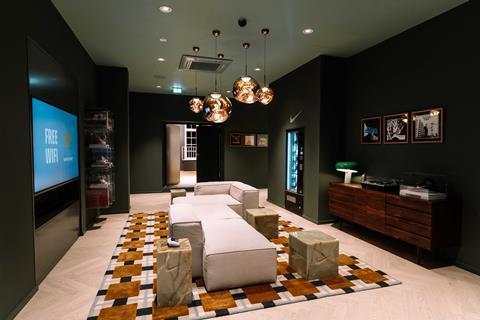
We are currently establishing this concept in Europe and have created a separate department for it. We are one of the pioneers here as the concept is not yet as established in Europe as on the other side of the ocean. One of my favorite examples is our Studio44 in Berlin Neukölln. There, we have a highly professional and fully equipped dance and recording studio integrated into our flagship store where kids from our community in and around Berlin can record songs and hold dance sessions for free.
Marketing Investments in Community Work
How much of your marketing budget do you spend on this community work?
In Europe, we already spend a decent amount of our marketing budget on these purpose-driven initiatives. Our goal is to increase this budget on a yearly basis. In the USA, it’s already more than 50 percent because we believe that this is the next level of being deeply connected. Of course, we will continue to do social media and will still be present at relevant festivals and events and work with the relevant testimonials in the industry. But we are shifting more and more towards community work.
Snipes’ Strong Market Presence and Growth
Snipes has grown enormously in recent years, also through acquisitions in other countries. Which are your strongest markets, and how many stores do you have?
We operate 800 stores worldwide, and the business is almost equally balanced. We are still a little stronger in Europe than in the US. In terms of total business volume, we are about 55 percent in Europe and 45 percent in the United States. In the US, we are present in Mid-America, on the East Coast, and in the Gulf region. In Europe, we are located in 11 countries. Of course, we have strong roots in the G-S-A region, but we also built up a very strong presence in Italy, Spain, and France, where we also see a lot of potential to continue to expand. We have plans for further growth, especially in Southern Europe.
The Role of E-Commerce for Snipes
What role does e-commerce play for you? What is the distribution of sales between brick-and-mortar and online?
Our e-commerce share accounts for about 20 percent of the total business, which means we are on target. Of course, we have ambitions to grow in both channels. However, for me, the more interesting question is: How can I combine the two even better?
We have invested a lot in our digital infrastructure in recent years, and we are currently moving our e-commerce to Scayle, the original About You platform. This is a huge project as it includes the whole Deichmann group. This combined with the implementation of a new ERP system, a multi-million-euro project, will allow us to grow much faster and work much more integrated with our stores. By the end of the year, we will be able to say that we have moved our existing multichannel approach to another level on the basis of the renewed e-commerce infrastructure.
What is the goal of your e-comm?
We would desire a 30 percent share. I believe that if we continue to develop solidly in both channels in a multichannel way, then we are on the right track.
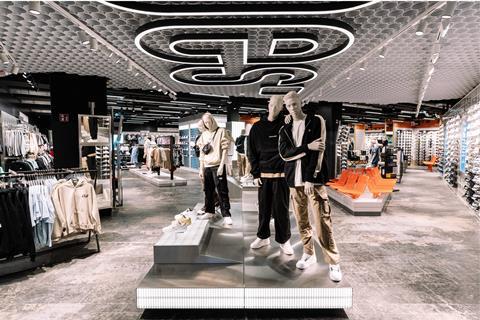
I need to say that our concept has grown through physical experiences. And that will always be a part of us. Here’s a story from my past: I worked at Nike for a long time, and Snipes was always perceived as a very event-driven company with almost 200 event days per year – before Covid. From small store events to big music festivals or basketball tournaments. Even now, after the pandemic, we are back to almost 80 event days a year in Europe. Physical experiences with the Snipes brand are essential. That’s why we also focus on experiences in the stores in addition to major events.
Snipes as a Licensee and Designer
Snipes is not only a retailer but also a licensee of many brands. Are you just a distribution partner, or do you go as far as designing?
There are different gradations. For example, we own the brand and handle the entire production and design process, or we do production for other brands due to our expertise gained in recent years. Additionally, we may simply act as the sales agency for a brand. So yes, we have our own product and design team here in-house. That means we produce textiles and shoes, and we can offer that in a wide range to the brands in our portfolio or just use it for the Snipes brand. So, we actually have three business models. One is the classic retail business, then the licensing business with brands, and the wholesale of these brands, which is also part of it. It’s an ingenious business model. I didn’t invent it myself; I inherited it.
It’s important to find credible brands like K1X or Karl Kani. No other brand stands for true hip-hop and streetwear more than Karl Kani. We are not only the ones who find those brands, but we are the ones who can significantly influence their positioning. It’s a very complex business model, but it’s a comprehensive one.
Which brands in the clothing sector are these?
There are many different ones. The most relevant for us are Karl Kani, K1X, Zoo York and Decibel. There are also a few more brands in the wholesale business.
Snipes’ roots are in the sneaker business. How is the sneaker market developing? People keep predicting the end of sneaker mania.
That’s actually not right: our origins weren’t sneakers. We’ve always been a head-to-toe outfitter. In the beginning, when there was only one Snipes store and hip-hop was still a niche, people came to us from all over Germany specifically to get baggy pants, wide hoodies, sneakers, but also spray cans, pens, Eastpack backpacks, and caps. So Snipes wasn’t originally a sneaker-driven concept, but it has become sneaker-heavy.
Stability in the Sneaker Market
And how is the sneaker market doing? Is the boom coming to an end?
No. I don’t think it’s a boom anymore; it’s something that’s here to stay. It’s not going to disappear. You can see a slowdown in the sneaker reseller market because there is a decrease in demand that might be caused by a high frequency of special releases over the years, and the demand is no longer higher than the supply. But basically, this has nothing at all to do with the products that we sell for the wider audience. So we are still seeing very stable growth here.
Which brands are very strong in sneakers right now?
It’s Adidas, especially in the last six to nine months. New Balance is just as important, though not to the same extent. But New Balance has had a huge impact on this whole modern running trend, and of course, that pushes brands like Asics and other competitors.
Nike’s Position in the Market
What about Nike?
We are seeing a decline, especially with Jordan, although Nike is still the clear number one in footwear in our concept.
Challenges in the Retail Sector
What are the biggest challenges in retail at the moment?
We all have to deal with the same issues as everyone who operates globally in retail and fashion: inflation, weaker purchasing power, and the uncertainties of being a global company. Of course, we are feeling the effects of reduced consumer sentiment, but so far we have always had the right answers and have managed to counter the difficult market situation.

Impact of Sports 2024
The global physical inactivity crisis is real. Our duty as an industry is to inspire a healthy and active lifestyle. That's why we're dedicating a new content series to the Impact of Sports.
>> Find out more.