For the first time in a quarter-century, the match ball supply contract for European club football’s flagship competition is open to competitive bidding. UC3, the UEFA–ECA joint venture managing commercial rights, has set a March 24 deadline for bids covering all three UEFA club competitions from 2027-28.
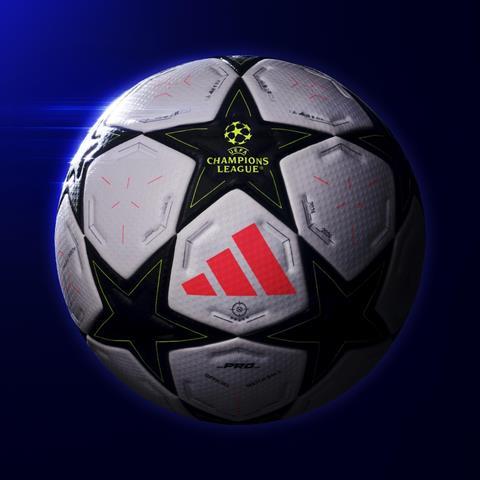
Adidas has supplied the official match ball for the UEFA Champions League (UCL) since 2001, but the German sportswear giant faces a competitive bidding process for the first time in 25 years after UEFA Club Competitions SA (UCC) – the joint venture between UEFA and the European Club Association (ECA) that controls the commercial rights for European club competitions – launched a formal tender for the category.
According to reports by SportsPro, Mundodeportivo and Sportcal, interested parties have until March 24, 2026, to submit bids. The scope of the tender extends beyond the Champions League to include the Europa League and the Conference League – a combined program of 531 matches per season. UCC and Relevent are reportedly open to awarding those competitions as a single bundled contract or as separate deals, according to SportsPro.
Puma leads the challenger field
Both Nike and Puma have been identified as potential bidders, though their competitive positions differ meaningfully. Nike is reported to be scaling back its investment in European football more broadly, while Puma has spent the past several seasons systematically displacing its rivals as the dominant match ball supplier across Europe’s major domestic leagues.
Puma ended Nike’s 25-year run as the official ball of the English Premier League at the start of this season, having already replaced the American brand in Italy’s Serie A from the 2022–23 campaign. The brand has also held the official ball contract for Spain’s La Liga since 2019–20. That competitive record makes Puma the most credible challenger for the UEFA business.
Adidas holds advantages beyond football
A renewal remains entirely plausible. Adidas not only supplies the UCL ball but also provides the official match ball for the FIFA World Cup and the UEFA European Championship — a breadth of tournament presence that has commercial value beyond any single contract. The brand is also set to return as the exclusive ball supplier for the Bundesliga and 2. Bundesliga from the 2026–27 season, in a deal announced last year.
Adidas’s financial position equally suggests a capacity to defend the contract. The company reported net income of €1.377 billion for fiscal year 2025 — a 67 percent increase from €824 million two years earlier — according to its 2025 annual report, as cited by Mundodeportivo.
A pattern of commercial resets
The UCL ball tender fits a broader pattern of UCC and Relevent restructuring the competition’s commercial partnerships to capture higher revenue from established rights categories. The beer sponsorship category offers the clearest recent precedent: international beverage company Anheuser-Busch InBev (AB InBev) entered an exclusive negotiation period with UCC covering the 2027–33 commercial cycle, reportedly offering as much as $230 million per year (€212 million) to replace Heineken, which had held the beer sponsorship since 1994 and last renewed in September 2023 for around $128 million annually (€118 million), according to SportsPro.
The current ball supply arrangements — Adidas in the Champions League and French sports retailer Decathlon in the Europa League and Conference League, where it has supplied balls since 2024 — are both set to expire at the end of the 2026–27 season.
The match ball tender process runs in parallel with the competition’s first global sponsorship sales cycle for the next rights period, launched in early October 2025, and with a broadcast rights process covering 19 markets across Europe, Central America and South America. Globally, UEFA is targeting a 10 percent uplift on the current rights package, which is valued at approximately $3.8 billion per year — with UCL clubs receiving close to 75 percent of the total proceeds.