Sports infrastructure – particularly publicly accessible facilities like football fields, basketball courts and outdoor gyms – is far more than a backdrop to athletic ambition. It is the foundation of physical activity, health equity, community cohesion and, ultimately, the future of the sports industry itself.

The benefits of physical activity have been well documented and discussed. But while the merits are clear, access isn’t always. And unless you limit yourself to jogging or biking, staying active often depends on having the right infrastructure. To hone your skills you need a court, a basket, a goal or a net. And that’s where the problem begins. All over the world, the absence or poor condition of municipal facilities bars entry – especially for underprivileged groups.
→ ”Physical Inactivity costs $300B by 2030” - Industry steps up with unified action plan
Sports infrastructure: The public sector is struggling to keep up
Let’s have a look at Germany, for instance. Providing solid sports infrastructure across the country shouldn’t be a problem for the world’s third-largest economy, you’d think. Well, think again. A 2025 study by German development bank KfW reveals that while 94 percent of German municipalities have indoor sports arenas and 92 percent have outdoor sports grounds, the coverage masks deeper structural issues. Around a quarter of municipalities have recently built new facilities, but over half report severe or considerable investment backlogs. Specifically:
- 59 percent of municipalities have indoor sports arenas overdue for investment
- 62 percent say the same of their swimming pools (which are settings for physical activity but also provide the foundation for a life-saving skill)
- 53 percent flag ice rinks as structurally outdated
The study finds in addition that the condition of facilities in over 40 percent of municipalities sometimes render individual sports activities impossible. And 36 percent fear they will need to scale back sports services soon.
Boys use public spaces more than girls
Public administrations face a familiar conundrum: infrastructure maintenance is costly, and funding is scarce. The result is patchy access, aging facilities and underserved communities – even as the societal need for physical activity continues to grow.
In the UK, the situation looks equally dire. According to the Local Government Association, over two-thirds of leisure facilities and swimming pools are past their expected lifespans or overdue for refurbishment – and are therefore energy-inefficient and costly to run. A 2024 survey by ukactive, a UK-based physical activity lobby, shows that 24 percent of council areas are at risk of closing or scaling back leisure services over operational cost increases; and 12.5 percent of private facilities had by the time of the study already shut down since October 2023.
And there’s another side. This is about more than the state of the facilities. It’s also about whom they serve and were designed for. “Boys use public spaces more than girls,“ said sports teacher and educator Petra Gieß-Stüber in an interview with German newspaper taz. “They push girls out either simply through their presence or through active behavior. For example, as soon as there’s a simple football field somewhere, girls won’t use it.”
Brands see the gap – and a strategic opportunity
Enter the sports brands. While many companies traditionally focus on sponsoring teams, leagues, running clubs, individual athletes or content creators, a growing number are redirecting resources into infrastructure – the spaces where sports begin.
According to the brands, this isn’t just altruism. It’s a long-term brand strategy. After all, the health of the sporting goods industry depends on the physical activity of people. Supporting public spaces where sport happens helps fuel future demand, shapes brand perception and fosters direct engagement with communities – even if it doesn’t translate into direct sales. Running across the Adidas logo on your daily after-school football match, hanging out in one of the brand’s outdoor gyms or taking a picture of Paris’ iconic Pigalle basketball court might just leave a mark.
Courts and community: Leading brand initiatives
While there aren’t hundreds to report on, global sports brands have launched a few initiatives to try to reshape urban sports environments across the world. Some are back-alley sports courts whose openings weren’t accompanied by PR festivities, while some are exactly that:
Nike & Pigalle Basketball Court, Paris
Tucked between buildings in Paris’ ninth arrondissement, the Pigalle Duperré court is a former parking lot that has become a symbol of creativity and inclusion – and maybe also a prime example of good out-of-home-marketing. First transformed in 2009 by designer Stéphane Ashpool with his fashion label Pigalle and design studio Ill-Studio with Nike’s support, the court has been reimagined five times, its motto being: “The Power of Sport to Move the World.” The latest renovation uses purple, blue and mint tones – a visual tribute to diversity and local culture. The surface is made with Nike Grind rubber, and the court is a must-visit for any basketball enthusiast coming to the city of love. And while Pigalle Founder Stéphane Ashpool has said that the court “birthed a community, […] fostered a family and inspired people” – and a basketball court is certainly more beneficial to the city’s health than yet another parking lot – the court feels a bit like a piece of carefully crafted brand storytelling rather than a meaningful move to tackle the deep-rooted challenges of accessibility and inclusion in sports infrastructure.
The Pigalle x Nike collaboration has kept growing, with courts in Beijing and Mexico City unveiled in late 2019. However, Nike has proven its commitment to enabling access to the sport for everyone with two other basketball courts.
Nike & Satou Sabally Court, Berlin
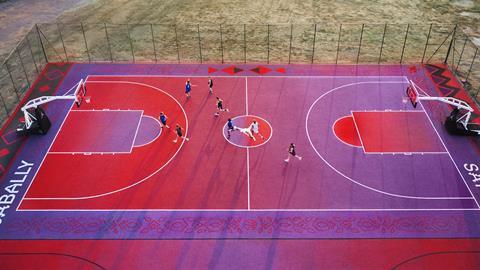
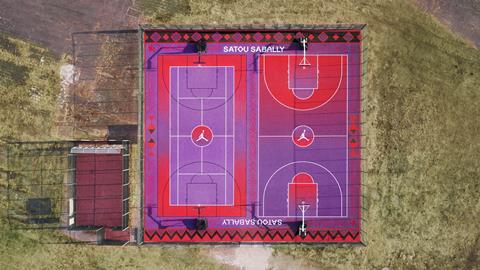
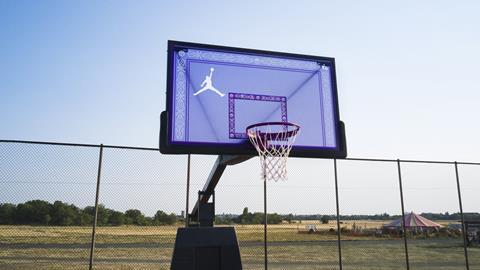
In her hometown of Berlin, WNBA star Satou Sabally and Jordan Brand revitalized a local basketball court at Tempelhofer Feld – a massive public park on the grounds of a former airport, well-beloved by Berliners and visitors from all over the world. “I’m very interested in the concept of intersectionality,” Sabally said during the opening ceremony. “As a woman, you have to constantly fight battles that other people never have to think of. Refurbishing the court is a small step in giving marginalized groups like young girls the same chance to play basketball, have fun and stay safe.”
Starting in 2022, the court offers free basketball for girls from all backgrounds, yet depends on the support of local partners like Sp0rt365, Türkiyemspor, Berlin Braves, Seitenwechsel and Here to Hoop Berlin. It is due to their continued support and engagement that the court continues to thrive. And while it has been opened for males, time slots have been reserved for female hoopers.
Adidas Urban Gyms & Sports Base, Berlin
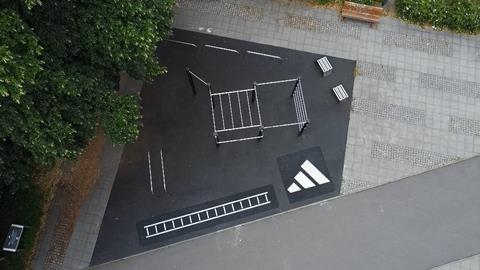
Adidas has anchored its Berlin community strategy in physical access. Through the Urban Gyms project and its flagship Adidas Sports Base, the brand offers Berliners free access to training spaces and organized activities at low costs. “We want to be where Berliners live and train, which is why we support existing communities like Dopamine or Beats and Burpees,” says an Adidas spokesperson. While the Adidas Sports Base is more lifestyle-oriented and maybe not as prone to attracting low-income groups (after all, the activities here are based around the shop), the Urban Gyms come at no cost and offer training opportunities for gym enthusiasts of all levels.
Other examples include Under Armour & Lents Park, Oregon – a grassroots refurbishment in partnership with Portland Parks, as well as the Adidas & Common Goal in Mexico City – a sustainable football pitch in a low-income neighborhood. It seems, to hazard a preliminary conclusion, that brands often provide an initial push (and funding) but long-lasting success comes from local and public players. The same goes for The Cage, the legendary NYC basketball court, which has been deemed “a triumph of private initiative” by the New York initiative City Lore, but whose continued relevance and vibrancy stem from deep-rooted community engagement, public access and an organic culture of streetball that keeps it alive far beyond the reach of brand campaigns.
Trade-offs: Who owns public space?
While private investment fills critical gaps, the presence of corporate-branded courts and pitches can raise uncomfortable questions. When brands “rescue” abandoned public facilities, do they also reshape who feels welcome there? Instagrammable courts like Pigalle might not necessarily draw the crowds that need access the most but rather hypebeasts looking to snap a colorful picture for likes. While brand engagement is critical, especially when public administrators fail to deliver services, such interventions risk turning public space into branded space, prioritizing marketing over inclusivity or leaving communities vulnerable to funding volatility if brand priorities shift.
Still, the revitalization of local sports infrastructure is urgent and overdue. Public funding shortfalls have created a vacuum – and brands are increasingly stepping in. Their motivations are complex: part philanthropy, part strategy, part brand identity. But when done right, this “brand urbanism” can benefit everyone.
The urban development experts of Stadmanufaktur suggest several rules for the success of the initiatives mentioned above: Successful implementation, they say, requires a clear framework that encompasses legal matters, economics and design:
- transparent rules for the presence of brands
- a focus on the common good
- close coordination between municipalities, companies and the population
If done correctly, the experts say, “brand urbanism offers cities and municipalities the opportunity to make public spaces more sustainable with a new source of resources.”