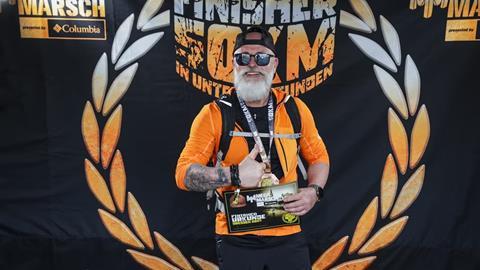
Participation sports events are growing fast and attracting younger, more gender-balanced audiences. The brand opportunity is real – but it demands a deeper playbook than logo placement on race-day banners.
We returned to the Eventrac Mass Participation Report 2025 – published in January of this year – after reading a blog post by sports marketing agency Infront Sports & Media that used its data to make the case for event sponsorship. Eventrac is a UK-based event management and marketing platform built specifically for mass participation sports events. Its annual report draws on booking, payment and participant data from events that have run on the platform for two or more consecutive years, making it one of the more grounded data sources in a space that tends towards promotional self-reporting.
Infront, as our readers know, has a direct commercial interest in the sponsorship argument it is making. It manages a portfolio of mass participation formats including HYROX, B2Run, XLETIX and Megamarsch. Its framing is not wrong, but it is narrow. Re-reading the Eventrac data with a broader lens, what strikes us is how much of the strategic opportunity it points to has little, if anything, to do with logo placement.
The headline figure – 7.8 percent year-on-year growth across like-for-like events in 2025 – is the kind of number that gets repeated in pitch decks. What matters more, for brand strategists, is what is underneath it.
The audience has shifted in ways that most brand strategies haven’t caught up with
The finding we keep coming back to in the Eventrac report is the demographic one. The 35–39 age cohort is now the single largest contributor to new participation, at 14.7 percent of all first-time entrants, with the 30–34 and 25–29 groups close behind. Participants aged 25 to 39 collectively account for more than 40 percent of new entrants.
Among the 20–24 cohort, the gender split has effectively reached parity – 49.7 percent female and 49.9 percent male. Strava data reinforces the picture: Gen Z was the fastest-growing demographic on the platform in 2025, with new clubs nearly quadrupling to one million globally.
| Age group | Share of new participants (2025) |
|---|---|
| 16–19 | 3.2% |
| 20–24 | 7.0% |
| 25–29 | 12.0% |
| 30–34 | 14.0% |
| 35–39 | 14.7% ▲ largest cohort |
| 40–44 | 10.5% |
| 45–49 | 11.0% |
| 50–54 | 7.8% |
| 55–59 | 7.4% |
| 60–64 | 6.2% |
| 65–69 | 3.2% |
| 70–74 | 1.0% |
| 75–79 | 0.2% |
| Source: Eventrac Mass Participation Report 2025. Like-for-like events. Figures approximate, read from published chart. | |
This is not the audience many brands built their mass participation activation strategies around. The 45-year-old male marathon runner as the default participant is a model the data is quietly retiring. Formats that feel exclusive, performance-gated or male-coded are, as Eventrac puts it, already starting to struggle for relevance. For brands still leading with that archetype in their event marketing, the misalignment is worth naming plainly. It is worth asking whether Nike’s messaging misstep at the Boston Marathon relates to this: what persona did they have in mind when they put “walkers tolerated” on a billboard?
The activation window is twelve weeks, not one morning
Eventrac’s booking data is where we found something that the sponsorship conversation tends to underweight. Participants booked events an average of 83.6 days in advance in 2025. January was the peak booking month – capturing more than 10 percent of annual registrations, driven by the familiar New Year resolution dynamic. September and October also showed strong volumes. The practical implication is that a participant’s relationship with an event, and with any brand present in its ecosystem, begins months before the starting gun.
| Age group | Avg. days booked in advance (2025) |
|---|---|
| 20–24 | 73 |
| 25–29 | 80 |
| 30–34 | 83 |
| 35–39 | 85 |
| 40–44 | 85 |
| 45–49 | 86 |
| 50–54 | 90 |
| 55–59 | 89 |
| 60–64 | 87 |
| 65–69 | 85 |
| 70–74 | 83 |
| 75–79 | 81 |
| 80+ | 58 |
| Source: Eventrac Mass Participation Report 2025. Industry average: 83.6 days. Figures approximate, read from published chart. | |
This directly connects to something we observed when we covered ASICS in our SGIE case study. What distinguishes ASICS’s approach in the running space is not its race sponsorships – it is the infrastructure it has built around the training journey itself: running clubs, guided training content, community presence at the grassroots level.
That model means ASICS is the brand someone encounters during the weeks they are logging miles, when they are actively deciding which shoe to train in. From this perspective, brands that compress mass participation activation into race day, or a few days before and after, are arriving late to their own opportunity.
Participants are spending beyond the entry fee – and the data tells you exactly where
One of the most commercially actionable findings in the Eventrac report is the merchandise attachment rate. In 2025, 14.5 percent of participants made optional purchases beyond their entry fee, spending an average of £16 (€19) per transaction. Clothing accounted for more than 45 percent of all add-on purchases, with event-branded apparel serving both as practical race kit and as a community identity marker. A separate 7.9 percent of participants chose to donate when given the option, which Eventrac reads as evidence of the emotional investment participants bring to events they have trained for.
| Add-on category | Share of add-on purchases (2025) |
|---|---|
| Clothing | ~46% |
| Service | ~25% |
| Medals | ~11% |
| Equipment | ~5% |
| Postage | ~4% |
| Camping | ~2% |
| Accessories | ~1% |
| Race extras | ~1% |
| Car parking | ~1% |
| Source: Eventrac Mass Participation Report 2025. 14.5% of all participants made add-on purchases in 2025, averaging £16 per transaction. Figures approximate, read from published chart. | |
The payment plan data adds another layer. When total basket value exceeded £200, nearly one in four participants opted to spread their payments. That is not a signal of financial constraint. It is a signal of willingness to commit to higher-value purchases, with flexibility as the enabling condition.
For sports nutrition, equipment and apparel brands, the add-on mechanic is a direct opening: participants are already in a purchasing mindset at the point of registration, and brands that can integrate product touchpoints into that flow are meeting genuine intent rather than generating it.
The event is the anchor. The ecosystem is the business.
The Infront piece correctly identifies what it calls the shift from events to ecosystems, and HYROX is the clearest example, as we previously featured on SGIE. In 2025 alone, HYROX attracted more than 750,000 athletes across 80 events in 31 markets, with a gym affiliation network that extends brand relevance well beyond event weekends. Structurally, HYROX is closer to a year-round membership platform than an event calendar.
What stands out is how neatly this maps to the ASICS model we detailed in our case study before – a brand building connective tissue between products, communities and physical experiences rather than buying a single day of visibility. The brands making the most of the mass participation boom are not those with the most prominent event logos.
They are those that have designed themselves into the ecosystem: the training content, the app integrations, the club kit, the gym partnerships and the post-event social layer.
Infront cites Intersport Germany and Columbia as Megamarsch partners, and MaxiNutrition as an XLETIX partner. These are useful reference points, but it is better to read them as category entry plays rather than finished strategies. The 26 percent participant return rate and the 8.5 percent referral and group entry rate in the Eventrac data suggest that community loyalty, once built, is durable. Brands that invest in depth across the full participation cycle, not just on event day, are the ones accumulating that loyalty rather than renting it for a weekend.
Three takeaways for brands (by category)
Footwear and apparel: the mass participation ecosystem rewards a long-game approach. The ASICS model is the clearest template: embed in the training journey through run clubs, local ambassador programs and co-created content distributed where participants actually plan their training – Strava, YouTube, community apps.
Sports nutrition, recovery and equipment: the merchandise and add-on data shows active demand. Participants are already primed to spend at checkout. Brands that negotiate integration at the point of registration – as bundled kit options, official recovery partners or checkout-level product prompts – capture willingness-to-spend at its most active.
Sporting goods retailers: the Intersport–Megamarsch model is a clear playbook: become the official kit provider for group participants and capture the group purchase wave that the referral and team entry data consistently shows. A 26 percent return rate across organizers is a loyalty signal that most retail contexts would envy.
Factfile
The 19-page Eventrac Mass Participation Report 2025, published in January 2026, also covers demographics, gender, and sports category trends. The data covers like-for-like events – those working with Eventrac for two or more consecutive years. Key metrics: 7.8 percent year-on-year growth; 35–39 cohort = 14.7 percent of new participants; 14.5 percent merchandise attachment rate; 75 percent of transactions via digital wallets; 26 percent participant return rate; 83.6-day average advance booking window.
Also recommended reading: Infront Sports & Media blog post, “Why mass participation sports marketing is a strategic growth opportunity for brands,” published 10 April 2026.