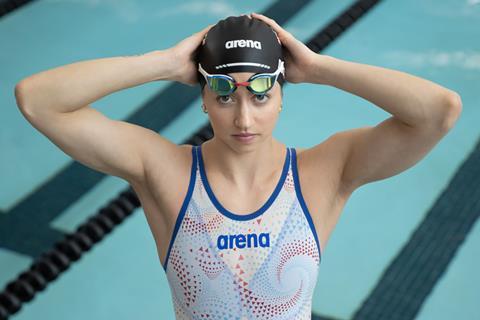
Arena, the international swimwear brand based in Italy, can look back on a successful summer of swimming: 40% of all swimmers at the Paris Olympics and a third of all medal winners wore Arena swimwear. But it is not only in professional sport that things are going well for Arena.
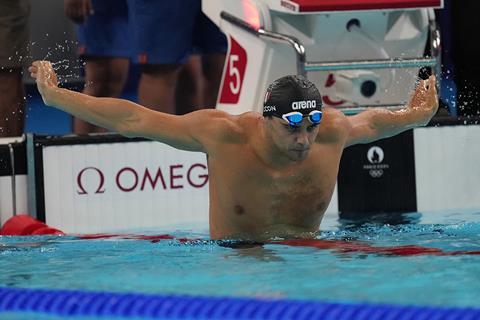
Founded in 1973 by Horst Dassler, son of Adidas founder Adolf Dassler, Arena celebrated its 50th anniversary last year with parties, fashion collaborations including Woolmark and Marcelo Burlon, and an extravagant stand at the Pitti Uomo menswear fair. And Arena became a Beneficial Company. Now, a year later, another big event was on the agenda: the Olympic Games in Paris.
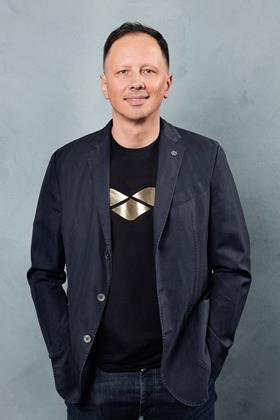
We spoke to CEO Peter Graschi about the importance of such major sporting events for the company and swimming in general, his predictions for the future of swimming, how the company works with its athletes, and his plans for sustainability.
SGI Europe: This year’s Olympic Games were held in Paris. Were you happy with the results?
Peter Graschi: Yes, we are very happy with the results. We had an improvement in the overall medal tally and a massive improvement in gold medals compared to Tokyo 2020. We had 40% of all swimmers competing in this year’s Olympic Games wearing Arena swimsuits. That was a huge success for us. Almost a third of the medals won in the pool or open water were won by athletes wearing Arena. Paris was also a magical place. We shared some magical moments with the team, with the partners, with the athletes’ families. For me personally, it was my first Olympic Games. I was not in Tokyo because of the very strict COVID restrictions.
Not a normal year in a good way
How important are major sporting events for your brand? Are Olympic years very different from normal years?
Yes, because the athletes are at the centre of our attention. For them, it’s the biggest moment of their career, and therefore for us. We are part of an ecosystem that helps the athlete perform at their best in this most important moment of their career. That motivates us tremendously and that is why we are focused on that moment to have the best product on the market to provide the best support.
Do you also need a higher marketing budget in such years?
More is spent on marketing in Olympic years than in other years, that’s for sure. Also, because everything around it takes more work and is more expensive. But it’s the most important moment for us and for every athlete, and it’s really different from the World Championships. It’s a different dimension.
And in terms of turnover, what effect do such major events have on your sales?
During the Olympic Games, especially during the swimming competitions, we see increased searches for arenas on the Internet. And we also see an increase in sales or demand, but not as much. The effect is more long-term. After the Olympics, most swimming clubs have more participants, and when the participants get their new equipment, they remember us. So it helps us in the long term to support swimming.
Graschi: “Fashion brands have a different view of the athletes”
Which athletes are you supporting?
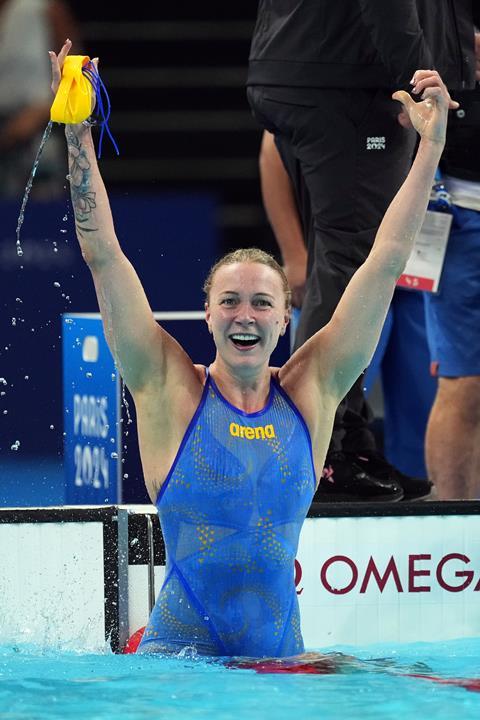
Actually, we’re supporting 20 federations and 40 Olympic and Paralympic athletes that were individually sponsored by Arena. Under them, we had Sarah Sjostrom, two-time gold medal winner, David Popovici, who in one of the most exciting and unpredictable races of the games became champion of the 200m freestyle, Jessica Long, the legend of Paralympic swimming, Kate Douglass, who won the 200m breaststroke, Thomas Ceccon, the first Italian ever to conquer Olympic gold in the 100m backstroke. Or Nicolo Martinenghi, who became the new Olympic champion in the men’s 100m breaststroke and Lukas Martens, who won gold and has been very close to setting a new world record. Also, Sharon Van Rowendaal, who won gold in the waters of the river Seine. Just to name a few.
What products do you equip athletes with?
We have to differentiate between the Olympic Games and the World Championships. For the Olympic Games, we are the technical supplier. The athletes wear the Arena swimsuit and cap, but the clothes outside the pool come from another sponsor. We have to differentiate between the Olympic Games and other competitions like World Championships, European Championships, Pan Pacific Games, etc. For the Olympic Games, we are the technical supplier of several aquatic federations. The athletes wear Arena swimsuits and caps, but the clothes outside the pool come from another sponsor - the technical sponsor of the National Olympic Committee. When it’s not an Olympic year, we provide both swimwear and sport apparel to the Swimming Federations sponsored by us.
Have you noticed that fashion brands are showing more and more interest in sponsoring athletes? Is there already some kind of competition?
Not really a competition. No. Fashion brands have a different view of the athlete and we support them in a different way. But sport, especially the technology of sport, is becoming more and more interesting for fashion. It is a cross-functional influence. So we look at what is happening in fashion and fashion looks at what is happening in the sports industry, especially in the development of fabrics.
How important are athletes as influencers and how do you work with them?
Yes, that is indeed a key component. We work very closely with them in terms of their presence on social media. With the help of our athletes, we stay very closely connected to the community. We also focus on how we communicate with our athletes on social media. Thomas Ceccon, for example, had huge success on social media after winning the gold medal in the 100m backstroke. His reach increased by 90% and the number of followers tripled. Thanks to a pilot program from WFSGI where some sports brands were involved in social media during the Olympics, we had a little more freedom to use the athletes for social media. And it actually had a very good effect. Non-Olympic partners have a lot of restrictions in terms of social media, but thanks to the new Road to Paris 2024 (IOC / WFSGI) Pilot program, eligible companies, like Arena, has more flexibility to use images of the athletes they sponsor – both during the qualification journey and at the Olympic Games themselves.
Do the athletes also work with you on your collections?
Yes, we also work with the Arena Elite Team athletes on product development. For example, when we developed the new Powerskin Primo racing suit, more than 400 swimmers participated, tested it, we held workshops with them and gathered their feedback. It took four years of development and 89 prototypes. But we also look to our athletes for design inspiration. The Fireflow design concept for the Olympic Games, which was very well seen on TV, was developed in workshops with the athletes from the arena Elite Team. our athletes.
Were these designs included in the collection afterwards?
Yes, they are usually included in collections that are only available for a limited time.
How does the Olympics influence your product development and collection?
Of course, in an Olympic year, we want to make sure we have the best product on the market. That’s the standard we set for ourselves. And this year we launched a new racing suit made of a completely new fabric. So not just an evolution, but really something completely new. And we had also a new racing goggles, the Cobra Edge. We will have another new development for the next Olympic Games, which we will present in three years. The lifestyle division is developing independently of racing. This year we did several collaborations with streetwear designer Marcelo Burlon, Woolmark and Japanese artist Shinpei Naito.
Arena: Eyes already set on Los Angeles 2028
What are your plans for the next Olympic Games in Los Angeles in 2028?
With our sights set on Los Angeles, we will continue to strengthen the team, with the objective of including key athletes from markets where our brand is well established. At the same time, we will identify new faces who can best represent new generations. For some time now, we have selected our athletes not just based on their athletic performance but also based on their characteristics.
How big is the proportion of performance and lifestyle in your collection?
We have three areas: Race, training - which is the biggest part of our collection - and we have the lifestyle part, which includes beachwear and bags and all pool-related products. In terms of percentages, it’s 20% 15% for race, 20% for the out-of-pool categories and 65% for training with swimwear and water equipment gear. and 60% for training.
Where do you see growth areas for the next few years?
I think swimming is becoming more and more popular and I am convinced that this is the beginning of a big trend as people realize the positive effects of swimming as a sport. It’s also low impact on the body, so you can swim at any level of fitness. In categories outside the pool, we are investing in beachwear, which has great potential because we have unique expertise in this area. We know how the body moves in the water, we know a lot about fit, we know a lot about fabrics and we have a unique story to tell. Our products designers are inspired by performance, so what we learn in racing, we bring to swimwear and beachwear.
Which markets are the most important for you right now?
Our biggest single market is the United States. Then there is Italy and the countries around Italy, like France and especially Germany. We have a good trend in Spain, in Eastern Europe and in Switzerland. The biggest growth at the moment is in the USA. Especially in racing. In the US Women’s Swimming, Arena was the most worn brand at the Olympic Games.
Brands are committed to improving their sustainable transformation. What are you focusing on?
We have a community impact plan based on three pillars. One of them is “Learn,” where we help communities learn to swim. Swimming is a life skill that everyone should master. The second pillar is called “Love”. Here we support events, swimming competitions and athletes. And the third pillar is “Protect”. Here we want to protect our natural habitat, the ocean. We work very closely with an organization called Helping Seas, which rescues ghost nets from the Adriatic Sea, which are then used to make recycled fabrics.
Arena: What it is like to be a B corp
You have just been certified as a beneficial corporation. What is that?
This is a legal form for companies in Italy. It comes from the USA and means a dual purpose company. We not only have financial goals, but also aim to improve the quality of life by promoting and enabling an active lifestyle in and by the water. We are also currently in the accreditation process to become a certified B Corp through the B Lab organization. We started this journey in 2022 and are confident that we will soon receive the B-Cop certification.
What measures are associated with this initiative for example?
Part of it was that we wanted to summarize our actions in the three pillars Learn, Love and Protect. The other part is that we have a clear roadmap with more than 100 measures, starting with remuneration, which makes management bonuses dependent on achieving sustainability targets. We have a beach and swimwear collection that is made from 100% recycled fabrics or organic cotton, and we are moving from plastic packaging to FSC-certified paper. We have also installed a program to give used wetsuits a second life. You can return the wetsuits to us and we upcycle them to new products. We do this in Germany.
Is it already possible to recycle swimwear due to the high percentage of spandex?
From our SS2025 collection onwards, 100% of our products - swimwear and beachwear - will be made from 100% recycled fabrics. However, it is not yet possible to recycle swimsuits due to the elastane content. We are working on that with our suppliers. Another technology we are working on is the elimination of microplastic. By the way, if you hand wash your swimsuit, you will massively reduce microplastic not get microfibers. So don’t put your swimsuit in the washing machine!