World Federation of the Sporting Goods Industry (WFSGI) put a number on something the sporting goods trade has argued for decades: that it does more than sell shoes and jerseys.
Released on 17 September in Geneva alongside Oliver Wyman, a Marsh business, The Industry That Moves the World is what WFSGI calls the industry’s first attempt to measure its own economic weight in full. As far as we can tell, it’s the most systematic effort we have seen so far, built from company disclosures, national statistics and trade data rather than a single source’s estimate.
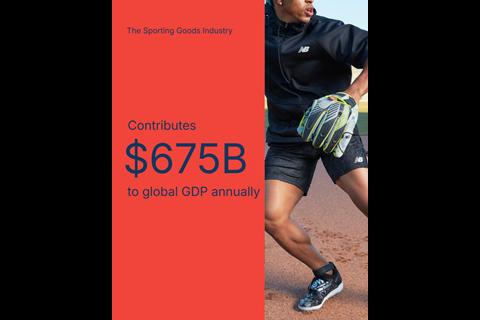
The first number that stands out is $675 billion in global GDP, WFSGI’s estimate of the industry’s total contribution once supply-chain and workforce wage-spending effects are counted alongside direct output, and roughly the entire annual output of Belgium.
The report lands with an argument attached, not just a figure.
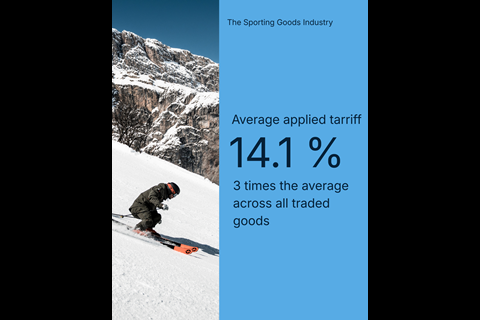
Sporting goods face an average applied tariff of 14.1 percent, nearly three times the 5.2 percent average across all traded goods and more than seven times the roughly 2 percent applied to medicines.
Layer on the consumption taxes and compliance costs that stack along the value chain, WFSGI argues, and the product ends up taxed like a discretionary extra despite measurably improving public health. SGI Europe has watched this tension build for years, in trade disputes, in sustainability commitments, in the slow realization that a running shoe and a pill solve adjacent problems.
This report put a dollar figure on it.
Numbers the industry never had
No single dataset had previously captured the industry’s full footprint; the figures were scattered across company filings, national trade statistics and retail data that never added up to one picture. WFSGI’s bottom-up model, built with member disclosures, national statistics and international trade data, puts the totals at:
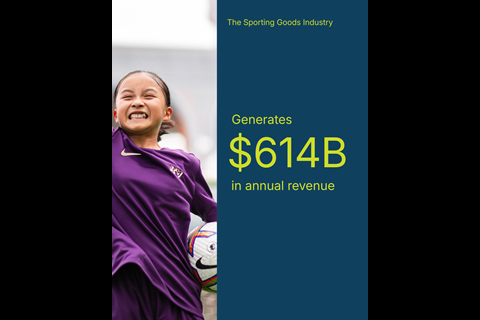
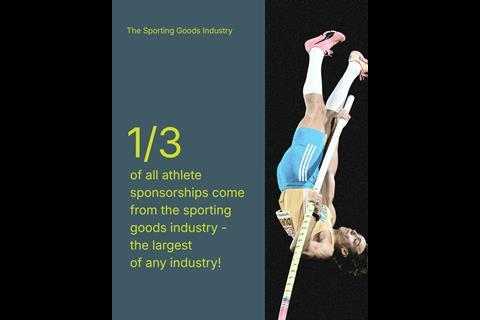
● Revenue: $614 billion a year across 210 consumer markets
● GDP contribution: $675 billion annually (total contribution, including supply-chain and wage-spending effects), about 0.6 percent of global GDP
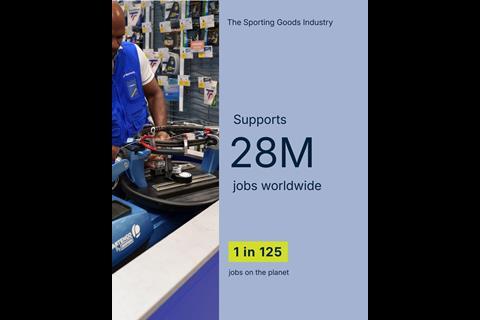
● Employment: 28 million jobs supported worldwide, one in every 125 jobs on the planet
● Tax revenue: $120 billion directly, rising to $230 billion including indirect effects
Manufacturing built to last, and to invent
Production spans 62 countries and reaches 210 markets, with about 70 percent of disclosed manufacturing facilities concentrated in six hubs: Cambodia, China, India, Indonesia, Chinese Taipei and Vietnam. That concentration is the product of decades of specialization: the report describes these hubs as internationally specialized manufacturing ecosystems built on supplier networks, technical know-how and logistics infrastructure. It stresses that value is created globally, in R&D, design, branding and commercial operations as much as in production, and that supply chain strategies continue to evolve as automation and AI reshape what can be produced where.
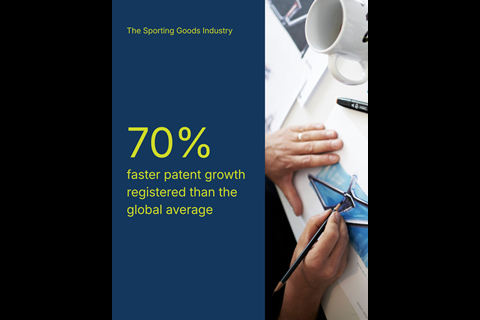
The industry has also become an innovation engine: sports-related patent filings grew 7.6 percent annually over the past decade, more than 70 percent faster than the patent economy overall, with over 65,700 sports-related inventions recorded between 2016 and 2025.

A luxury tax on a health product
The report’s sharpest argument sits in the gap between two numbers. The entire global tariff take on sporting goods, an estimated $8 billion to $15 billion a year (an Oliver Wyman analysis), is at most about half of what physical inactivity costs health systems annually: $30 billion to $48 billion, by the report’s estimate, drawing on Lancet Global Health and WHO data. Globally, 1.8 billion adults, more than the population of India or China, don’t meet recommended activity levels, and that share is projected to climb from 31 percent to 35 percent by 2030.
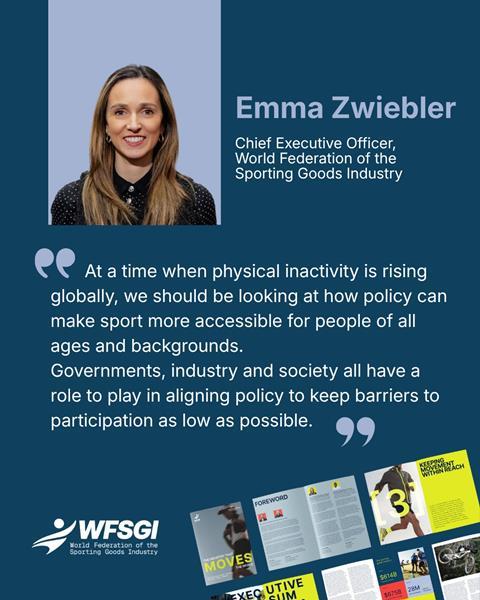
The report delivers an extended argument across three priorities meant to orient policy; the short version:
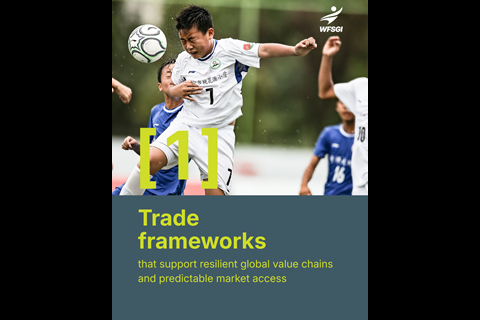
1. Trade frameworks that keep global value chains predictable and market access open, rather than exposed to tariff shocks;
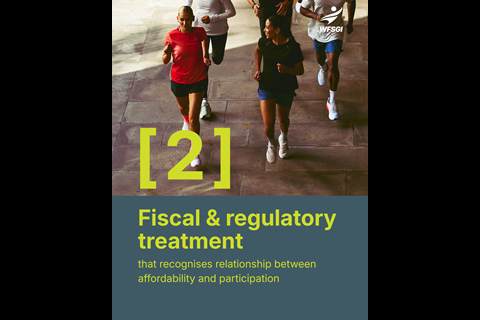
2. Fiscal and regulatory treatment that treats affordability as a direct driver of participation, not a side issue;
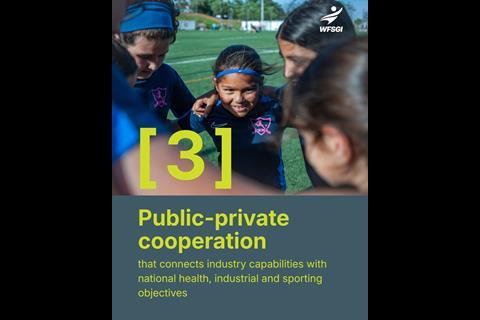
3. Public-private cooperation that connects industry capacity and reach to national health, industrial and sporting goals.
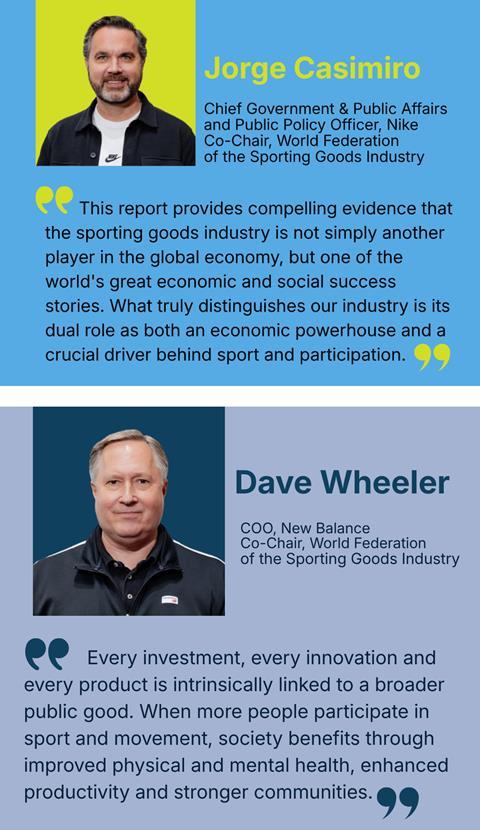
Jorge Casimiro of Nike and Dave Wheeler of New Balance, WFSGI’s co-chairs, describe the report in the foreword as “both a benchmark and a platform: a benchmark for understanding our impact, and a platform for advancing the partnerships, policies and investments that will enable even greater success for the global economy and society as a whole.”
The SGIE take
The Impact of Sports is also at the very heart of SGI Europe. As noted above, physical activity levels are declining while climate change and the loss of natural spaces erode the environments people move in. As a result, the Oliver Wyman analysts put $169 billion of projected sporting goods industry revenue — about 27 percent of the total — at risk. This is why we dedicate an yearly special to this topic, which defines the purpose of our industry.
We discuss how industry players are tackling this challenge, explain why sports brands invest in critical infrastructure, and highlight successful movement campaigns.
And that’s not all: together with WFSGI, we also run a Coffee Break Webinar Series dedicated to Impact of Sports. The next episode is already in the making — but you can watch the last episode, featuring Decathlon and adidas on event activation, on demand.
WFSGI published The Industry That Moves the World: Sporting Goods Industry Economic Impact Report on Sept. 17, 2026, in Geneva, developed with Oliver Wyman, with additional contributions by FESI, SFIA, PeopleForBikes and the European Cycling Industries (ECI). The full report can be downloaded at wfsgi.org.