VF Corp’s third-quarter results highlight an ongoing transition: growth at The North Face and Timberland partly offset Vans’ decline. A targeted free cash flow of more than $600 million for FY26 signals progress, though currency effects and regional headwinds continue to weigh on recovery.
A strong dollar, sluggish consumption, and legacy issues from restructuring are slowing VF Corp in the third quarter – the sales and earnings figures clearly show how challenging the road to recovery remains. Nevertheless, management is emphatically confident: “In Q3, we delivered growth during our peak holiday quarter and beat revenue and operating income guidance,” said CEO Bracken Darrell. He is equally positive about the core brands The North Face and Timberland, which reported 8 percent growth year on year, or 5 percent on a constant-currency basis, in the third quarter.
Group figures under pressure – portfolio and FX effects
On a GAAP basis, VF Corp reported revenues of $2.88 billion in Q3 FY26, representing a 1 percent increase year on year. Reported operating income rose to $289 million, up from $226 million in the prior-year period, supported by lower impairment charges and disciplined cost control. Net income from continuing operations increased to $301 million, with diluted earnings per share of $0.76, underscoring a materially stronger reported earnings profile despite ongoing currency headwinds and portfolio-related distortions following the divestments of Supreme and Dickies.
| VF Corp. - Reportable segment information | ||||
|---|---|---|---|---|
| GAAP | Adjusted for forex | Constant currency | ||
| Q3, ended Dec. 2025 ($ thousand, constant currency) | ||||
| Revenues | ||||
| Outdoor segment | 1,926,008 | -53,668 | 1,872,340 | |
| Active segment | 671,835 | -17,774 | 654,061 | |
| All Other | 277,958 | -6,736 | 271,222 | |
| Total revenues | 2,875,801 | -78,178 | 2,797,623 | |
| Segment profit | ||||
| Outdoor segment | 407,726 | -11,820 | 395,906 | |
| Active segment | -4,622 | -1,645 | -6,267 | |
| Total segment profit | 403,104 | -13,465 | 389,639 | |
| Impairment of goodwill | -30,716 | – | -30,716 | |
| Corporate and other income (a) | 10,030 | 397 | 10,427 | |
| Interest expense, net | -34,611 | -479 | -35,090 | |
| “All Other” profit | 15,052 | -141 | 14,911 | |
| Income from continuing operations before income taxes | 362,859 | -13,688 | 349,171 | |
| Diluted earnings per share change from continuing operations | 76% | -6% | 70% | |
| 9M, ended Dec. 2025 ($ thousand, constant currency) | ||||
| Revenues | ||||
| Outdoor segment | 4,401,953 | -103,023 | 4,298,930 | |
| Active segment | 2,132,272 | -41,285 | 2,090,987 | |
| All Other | 904,948 | -18,495 | 886,453 | |
| Total revenues | 7,439,173 | -162,803 | 7,276,370 | |
| Segment profit | ||||
| Outdoor segment | 666,196 | -18,815 | 647,381 | |
| Active segment | 117,964 | -6,258 | 111,706 | |
| Total segment profit | 784,160 | -25,073 | 759,087 | |
| Impairment of goodwill | -30,716 | – | -30,716 | |
| Corporate and other income (a) | -190,202 | 1,017 | -189,185 | |
| Interest expense, net | -121,940 | -1,473 | -123,413 | |
| “All Other” profit | 63,245 | -2,103 | 61,142 | |
| Income from continuing operations before income taxes | 504,547 | -27,632 | 476,915 | |
| Diluted earnings per share change from continuing operations | 69% | -11% | 58% | |
| (a) An estimated pre-tax gain on the sale of Dickies of $139.1 million was recorded in the other income (expense), net line item in the Consolidated Statement of Operations for the three months ended December 2025. In addition, a pension settlement charge of $34.0 million related to the termination of the U.S. qualified plan was recorded in the other income (expense), net line item in the Consolidated Statement of Operations for the three months ended December 2025. | ||||
| Source: VF Corp. | ||||
Supreme and Dickies sold: Focus on core brands
The Californian lifestyle group, which owns brands such as The North Face and Vans, divested itself of legacy assets in 2025 – but not without some controversy. With the sales of Supreme and Dickies, VF Corp is sharpening its portfolio and clearly focusing on labels geared towards outdoor, active, and lifestyle brands. While Supreme is clearly listed as a “discontinued operation,” the Dickies deal is causing confusion in the balance sheet: the brand remains included in the GAAP figures, which makes comparability difficult. This makes the additionally published “ex-Dickies” key figures all the more important. One thing is clear: the portfolio streamlining strengthens the strategic focus, which dilutes the margin profile in the short term – and the sales potential of the new VF residual structure has yet to be proven. The performance of the remaining core brands in the third quarter paints a mixed picture.
The North Face remains the group’s strongest brand anchor
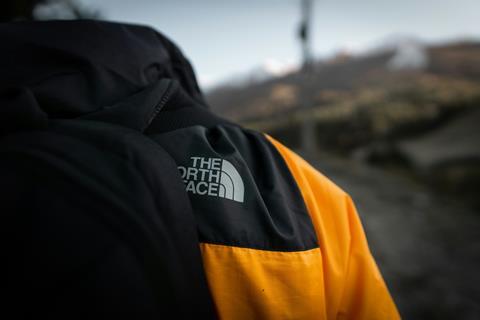
With sales of $1.36 billion in Q3 FY26 (prior year: $1.25bn), The North Face remained the largest brand in the group, accounting for roughly 47 percent of total revenue. On a reported basis, brand sales increased by 8 percent year on year, or 5 percent on a constant-currency basis, underscoring the continued resilience of the outdoor franchise despite a challenging consumer environment. Demand for technical outdoor apparel remained solid through the quarter, reinforcing The North Face’s role as VF Corp’s primary earnings and cash-flow anchor heading into Q4.
Vans still under pressure
Vans recorded a significant decline of 8 percent. The problem child in the portfolio generated sales of $558 million in Q3. This corresponds to around 19 percent of consolidated sales. The downward trend is thus continuing (Q2 FY26: 9%). Even though this trend is slowing down, the structural problems in brand positioning seem to persist, even though Vans “performed as expected” according to Darrell. In this context, VF points to progress in streamlining the product range and reducing inventories, but industry insiders do not yet see a sustainable reversal of the trend. Accordingly, the group has announced further measures to stabilize and realign the brand.
Timberland grows despite a challenging market
Timberland generated sales of $570 million, which corresponds to around 20 percent of consolidated sales. On a reported basis, revenue increased by 8 percent year on year, following a solid increase in Q2. The brand remains a reliable revenue contributor, particularly in North America and EMEA, although demand in the premium footwear segment continues to be shaped by a cautious consumer environment. New products and collaborations are beginning to have an impact.
Strong momentum at Altra, mixed trends in the rest of the portfolio
The remaining brands – including Altra, Icebreaker, Eastpak, JanSport, and Smartwool – generated combined sales of $392 million, representing around 14 percent of total revenue. While the category declined by 12 percent on a reported basis, this headline figure masks significant differences across the portfolio. Altra once again delivered double-digit growth, whereas more mature brands such as JanSport and Eastpak continued to face pressure. By contrast, Smartwool and Icebreaker showed comparatively resilient performance, supported in part by ongoing momentum in the DTC channel.
North America stabilizes, EMEA cautious, APAC under pressure
Regionally, the familiar but still fragile picture emerges: North America remains the most important anchor of stability for VF Corp, supported by The North Face and slowly normalizing demand in wholesale. Price discipline, fewer promotions, and better inventory management are increasingly providing support here.
EMEA continues to develop cautiously. High wholesale inventories, cautious order cycles, and ongoing consumer restraint are weighing particularly heavily on the lifestyle and footwear segments. While outdoor categories are proving comparatively stable, many retail partners in the region continue to prioritize balance sheet discipline over aggressive reordering, which is limiting short-term growth.
APAC remains under pressure, with reported revenues declining year on year across both reported and constant-currency bases. While DTC and selected metropolitan markets continue to show pockets of resilience, these have not been sufficient to offset broader weakness across the region. As a result, APAC currently remains a drag on group performance rather than a meaningful growth contributor.
Against this backdrop, VF Corp’s operational recovery is currently less a question of regional expansion. Rather, portfolio focus, margin discipline, and stringent capital allocation are crucial. Especially in an environment where regional demand alone does not enable a rapid turnaround, these internal control levers come to the fore.
Cautious outlook: focus on cash flow and margins
Despite the challenging third quarter, VF Corp is sticking to its targets for the year as a whole – with adjusted priorities. For the fourth quarter, the company expects currency-adjusted sales to decline by 1 to 3 percent and adjusted operating profit to be between $10 and $30 million. For the year as a whole, sales and operating profit are expected to improve slightly compared to FY25, primarily through efficiency measures and portfolio adjustments.
Particular attention is being paid to free cash flow, which management estimates at over $600 million for FY26 – a noticeable increase compared to the previous year. The impact of tariffs and restructuring costs is expected to be offset in the medium term by savings and price adjustments. However, VF does not expect to see a complete recovery until FY27. But Darrell remains optimistic: “We remain on track to deliver our medium-term financial targets and are excited about the future of the business.”