Kant is a prominent Russian sporting goods retailer and distributor. Launched in the late 1980s, the company gradually became the biggest distributor in the market, cooperating with 280 dealerships and 500 sales points nationwide. It also runs 25 stores under its own banner and has a well-elaborated infrastructure involving a sports complex, a ski ramp, a ski school, a rental point and a service center. An interview with Maxim Vinogradov, VP of Russia’s retailer Kant.
Kant made its first steps in the twilight of Soviet times when a painful transition towards a market economy left the Russian sporting goods market in short supply. “At that time, the basic business concept was to help mitigate the deficit in the country,” recalls Maxim Vinogradov, Vice President and co-owner of Kant.
In the 2000s, the business naturally grew into a retail chain in which the main focus was on six sports: alpine skiing, snowboarding, cross-country skiing, hiking, rollerskating and cycling. Over the years, the company became the exclusive distributor of the leading Western brands in Russia. This list includes Elan, Nidecker, Jones, Now, Yes, Rocky Mountain, Welt, Hamax, Alpina, Buff, Kama, Asolo, Deuter, Dolomite and Reusch. Kant also holds non-exclusive agreements with dozens of other big names in the industry.

A lost win-win

In 2017, Kant jumped into a landmark cooperation agreement with Decathlon, under which it set up four shop-in-shops in the French retailer’s stores in Russia. This project was revolutionary for Russia’s sporting goods retail market.
“Decathlon was exceptionally successful in Russia in selling sporting goods in the mass segment but lacked more sophisticated products,” Vinogradov explained. The partnership, under which roughly a third of a 3,000 to 4,000 sqm shopping space was given to Kant, helped the French company to fill the gap and offer products for all tastes, from novice athletes to advanced users.
Despite giving up a part of the shopping space, Decathlon saw a rise in its own sales, owing to the additional customer traffic Kant secured, Vinogradov added. The idea clearly paid off for both sides, and the experiment was due to be expanded in the years to come. “However, life brings up adjustments to any great plans,” Vinogradov said. As Decathlon pulled out from Russia and sold its retail business in the country to a company called ARM, the project was wrapped, and only one out of four stores continues operation independently now.
Since December 2023, some former outlets of the French retailer have been put back into operation, but reviving the cooperation with Kant is not in the cards. “The management [of former Decathlon business in Russia] doesn’t believe in this synergy we used to have.” Kant would be happy to consider similar cooperation, but Vinogradov believes there is no partner in Russia’s joint project that will provide similar development opportunities. Decathlon was a perfect match. “[Russia’s largest sporting goods retailer] Sportmaster has been trying to develop a similar shop-in-shop format with its Sportmaster Pro concept for nearly a decade, but working on mass segment with one hand and professional segment with another is a tricky task,” Vinogradov added.
In the uncharted waters
Aside from Decathlon’s departure, 2022 hit Russia’s sporting goods retail market with an unprecedented logistical crisis. The crisis became a challenge for Kant, just as for other Russian sporting goods market players. Eventually, the company overcame most of the difficulties, Vinogradov said, refraining from diving into details, explaining that “some sensitive issues” were involved. The product range narrowed in some categories, but the shelves in Russia generally remained stocked with sporting goods. “Some brands have left, and some brands have come. But this is just how retail business works. The holy place is never empty,” Vinogradov added.
Coupled with the Russian ruble’s currency exchange fluctuations, this factor triggered price swings in the market. Vinogradov emphasized that the price dynamics in the Russian sporting goods market were mixed: while some items noticeably jumped in price, others experienced little to no growth.
Two controversial tendencies influence the demand in the Russian sporting goods market. On the one hand, it is under pressure because of economic difficulties, but as the Russian authorities pump substantial sums of money into the national economy, the decline in sales is relatively slight, according to Vinogradov.
Immigration is among the main reasons for waning demand. However, this factor is compensated by travel restrictions, which are forcing wealthy customers who used to enjoy their holiday at European ski resorts to spend money on their home grounds. “As a consequence, Russia experiences a boom of investments into ski resorts,” Vinogradov said. “This process is not fast, and it is yet to bring tangible results, but judging from the current tendencies, in four to five years, we will have two or three times bigger ski resort capacities than now.” Besides, Vinogradov said he expected more people in Russia to start exploring various opportunities offered by winter sports. “The bottom line is that sales are falling, but there is a tendency for stabilization, and we believe the long-term outlook is bright,” Vinogradov explained.
Against the odds
Although demand in the Russian sporting goods market has dipped in the past couple of years, paradoxically, all retailers are performing well. “The exit of a substantial number of players allows those who remained in the market to grow in revenue and profit and to keep a good pace of development,” Vinogradov stated.
For example, Adidas and Nike officially ceased working in Russia, but their businesses in the country were swiftly picked up by local firms that re-opened the stores, where they sell the same Adidas and Nike goods, according to Vinogradov.
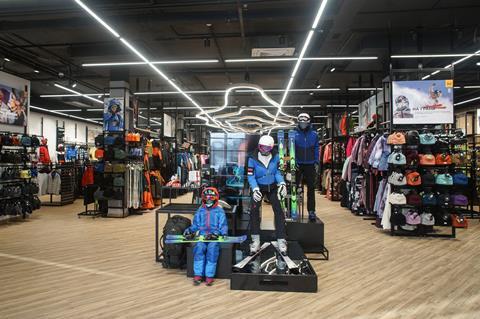
Kant has also joined the development frenzy typical for Russian sporting goods retail. At the end of 2023, the company launched a big store in Novosibirsk, which will help it gain a foothold in Siberia, Vinogradov said. Based on the big brick-and-mortar outlet, Kant management plans to develop its own delivery system and expand its e-commerce business in this part of Russia. “We also see that due to the departure of some [competitive] brands, our distribution business expands by an order of magnitude,” Vinogradov revealed.
In addition, the departure of Western brands from Russia has given Chinese and local sporting goods manufacturers a chance to anchor themselves in the market. Chinese companies have dramatically expanded their presence on the shelves of Russian sporting goods stores, Vinogradov said. Unlike Western companies, Chinese manufacturers put little effort into promoting and marketing their brands. This leads to poor recognition among customers. On the other hand, many Chinese suppliers offer products of decent quality.
Vinogradov said the future outlook remains somewhat vague, stressing that it clearly depends on “numerous geopolitical factors that are hardly predictable.” However, the basic scenario upon which Kant drafts its development plans envisages no big shocks in the foreseeable future. In the coming years, the company plans to prioritize retail business development at Russian ski resorts, including those at the construction stage, Vinogradov concluded.