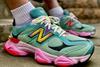
New Balance has been something of a phenomenon within the sporting goods industry. Initially founded over 100 years ago, it has always remained a private company and one that has kept its manufacturing largely US-based. Today, it stands as one of the most globally successful footwear brands, with over 4000 retail locations worldwide and staggering year-on-year growth driven by its successful efforts to attract new customers.
- New Balance, a private company, is within the top five biggest-selling sneaker brands in the world
- It is aiming to reach $10 billion in sales within the next few years
- Its CEO credits strategic brand partnerships as being central to the company’s success
New Balance Headquarters Relocation and Expansion Marks Growth Period for the Brand
In 2023, New Balance’s President and CEO Joe Preston took part in a series of interviews to share the company’s financial performance. In these, he revealed that the business had reached $6.5 billion in annual sales and growth of $1 billion a year for three consecutive years. This placed it as the fourth-biggest sneaker brand after Nike, Adidas and Puma, respectively, while it was at the top of the list in terms of percentage growth year-on-year.
Following these successes, a raft of investments has subsequently been announced. $65 million was pledged to expand the company’s athletic footwear manufacturing facility in Skowhegan, Maine, and $70 million was allocated towards the construction of its 9,500-sqm factory in Londonderry, New Hampshire. Now, New Balance has just revealed that it will be relocating and expanding its European headquarters in Amsterdam, moving from its office in Houthavens to 3,865-sqm premises called A-Factorij, which is within a 1950s former bicycle manufacturing plant. Located in the Schinkel district, it will include creative office space, showrooms and a content studio, and will initially house over 150 employees when it opens in Summer 2024.
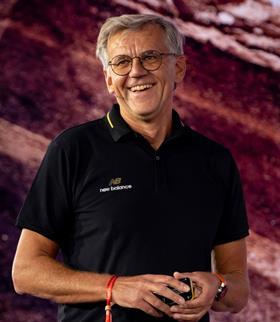
“We are delighted to be relocating to such a highly innovative, creative, and vibrant area which reflects the character and personality of the New Balance brand so well,” said Mathias Boenke, New Balance’s Senior Vice President for the EMEA region. “Above all, the planned expansion of our EMEA headquarters stands as a testament to the brand’s powerful and sustainable growth, particularly within Europe.”
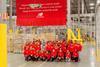
New Balance has its global HQ in Boston and a total of five manufacturing facilities across Maine and Massachusetts, all employing a combined workforce of around 1,300 people. The company also has a large footprint in Europe, however, not only with the Amsterdam site but with another seven offices across Europe as well, including a factory in Flimby in the north-west of England, which employs over 300 people. Its workforce in Europe comprises a total of 2,379 associates, dispersed across 15 countries.
In an interview with Yahoo Finance, CEO Joe Preston said that growth had been consistent in every single region it operates in throughout the globe, highlighting particular success within Europe. “In 2023 Europe grew by over 35 percent,” he revealed, “but the US has also been up by 20 percent for three consecutive years.”
The company entered 2024 with the ambition to open 90 new shops around the world, with Australian cricket captain and New Balance ambassador Pat Cummins cutting the ribbon on the latest store in Mumbai earlier this spring. It will also have a presence at the Summer Olympics in Paris this year, having announced that it will be hosting a meeting point for athletes at the Place de la République.

Brand Partnerships Are Central to Its Growth
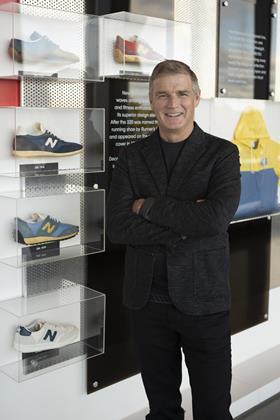
Boston-born Preston, who started his career at New Balance as a product manager in 1995, credits “innovation, brand activation and operational excellence” as the three pillars behind the company’s successes in recent years. He particularly values its 350+ partnerships with athletes and ambassadors.
“I think they’ve had a tremendous impact,” commented Preston. “Our brand teams have done a great job of connecting sport and culture, and that’s bringing energy to the brand and new consumers to the brand. In fact, 63 percent of our online customers last year (2023) were new customers.”
New Balance began in the Boston area in 1906 when English immigrant William J.Riley began making arch supports and other shoe accessories designed to provide greater comfort and fit. In the decades that followed, leading athletes became drawn to New Balance’s products, and this would eventually prompt the creation of the first New Balance shoe in 1938. In 1972, Jim Davis purchased the company, which at that point still only had six permanent employees making thirty pairs of shoes a day. New shoe models were released, including the New Balance 320 and 305, and these would subsequently be named the world’s best running shoes by Runner’s World magazine.
New Balance’s efforts towards athlete sponsorship began in earnest in the 1980s when basketball player James Worthy became the brand’s first athlete to have a signature shoe. The partnership would go down in history as the first-ever $1 million contract between a company and an NBA athlete.
This athlete sponsorship strategy came to a very sudden halt in the early 1990s, however, with the business adopting the tagline ‘Endorsed by No One’. This was part of a marketing strategy intended to position New Balance as a brand that focused purely on the product itself, suggesting that a good shoe would sell based on its merits rather than celebrity influence.
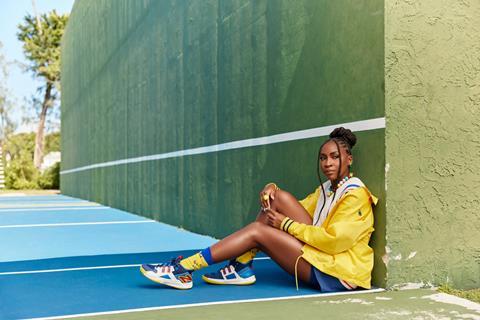
New Balance eventually fell back into line with its main competitors, and today it has the likes of 2023 US Open winner Coco Gauff, Stanford NBA star Cameron Brink and Chelsea and England football player Raheem Sterling all now part of its roster. Its partnerships extend to global pop stars too, including Gigi Hadid, Timothée Chalamet and Zoë Kravitz while it has also sponsored the likes of Liverpool FC and the London Marathon.
An Old Company Staying Relevant
To this day, the Davis family owns 95 percent of the company. Jim Davis still serves as chairman while his wife Anne Davis is the vice chair. Putting to bed any speculation that the business might join its main rivals in listing its shares on the stock market for public trading, CEO Joe Preston was quoted as saying that “the company has been private since it was founded and I think that’s going to continue.”
The focus is instead on continued growth, with the ambition to hit annual sales of $10 billion within the next few years. Preston has said that New Balance will be turning to innovation to drive this. “We do believe that the next big revolution is going to come in materials,” he commented. “It’ll be plant based or something that will revolutionize the industry.”
One thing that’s for certain is that the company faces some stiff competition in pursuit of these targets, not only from its old rivals, Nike, Puma and Adidas, but also from the likes of Hoka and On, two footwear specialists that burst onto the scene in the 2010s. The two brands are quickly swallowing up market share. Banking experts are predicting that by 2034, On sales will skyrocket to $18.56 billion, while shares in Hoka-owner Deckers are up by 35 percent since the beginning of the year having risen by a whopping 67 percent in 2023. For some perspective, in the same period Nike saw a drop of 15.2 percent.
Still, while sneaker culture tends to demand newer and more eye-catching products, New Balance has always chosen to hunker down, focusing on its core values and sustainable growth and continuing to stick with its classic designs. Fashion titles have previously called it the ‘sensible sneaker’ brand and the company appears to wear that perception with pride – as recently as 2019 it even ran the tagline ‘worn by supermodels in London and dads in Ohio’. It’s an approach that’s certainly worked well for the company in the past and it’s looking likely that it will continue to do so into the future.