In a recent press conference on New Wave’s Q2 results, the company announced that it will start selling teamwear products in the US. SGI Europe caught up with CEO Torsten Jansson to hear more details about the company’s plans in North America, its plans for its latest acquisition, Tenson and its plans to acquire even more companies in the sports industry.
SGI Europe: What is your secret recipe for success in the US?
Torsten Jannson: The main thing we can compete with is that we have had a fantastic teamwear development in the Nordic countries and Europe. Here we have been able to compete with international brands like Adidas and Puma and more local ones like Jako and Hummel. What we have also invested in Europe is to have substantial stocks. This has enabled us, above all, to deliver quickly and reliably to our customers. Therefore, it has not been relevant to invest in the US until we can do the same in that market. In addition, to succeed with teamwear, it has benefited us that we have not been afraid of capital commitment. We are used to having one-color jerseys and polos with a billion in inventory value. We can do that because we know that the associations we work with are based on the same colors and models, before they are printed by us.
New Wave’s strategy for the US market
Tell us what you think about your teamwear venture in the US.
We have had a subsidiary in the US for a couple of years that, among other things, ran our shoe initiative. Ahead of our teamwear venture now, we have analyzed the American market for a couple of years. By meeting potential customers and retailers. We will focus on building up our product stock for the US and Canadian markets. This will happen now in Q3 and Q4 2024. This build-up takes some time due to lead times from our production countries, which are mainly in Asia but also in North Africa. Therefore, we expect to be able to compete on the same terms as other suppliers in North America by the middle of next year.
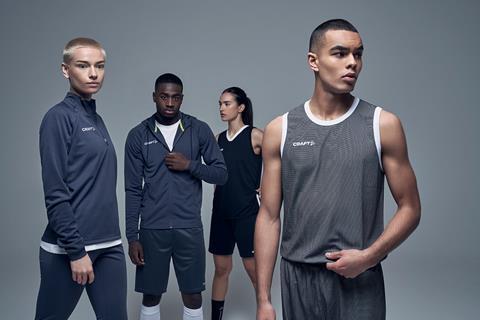
The competition is tough in teamwear, but you have succeeded well with Craft over the past ten years and also outside Sweden when we talk about handball, floorball and, in recent years, your investment in football. What are New Wave’s advantages compared to your competitors?
Firstly, we decided right from the start to have the same number of products for both men and women with the right cut for both sexes. We knew we would never be a player that offered smaller men’s sizes to the ladies in the clubs we work with. With our other companies that produce corporate clothing and gift items, we can offer our customers sports shops and clubs a complete merchandise production in addition to pure base textiles. In comparison with our competitors, we are quite unique. For example, the Swedish top club Hammarby IF (second in the highest league right now) has been able to increase sales of merchandise by 300 percent since we became their supplier of teamwear and merchandise. In addition to shirts, overalls and shoes, they can also offer the club’s fans kitchenware and glasses with the club brand engraved on them. A pure textile company cannot do that.
Find out more about New Wave’s financials
You sponsor top European football clubs. What do you think about sponsoring American clubs?
We are building from the bottom up. We will pick up someone big, and now, in the beginning, focus on ÅF and stores. We debate a lot about logistics and delivery reliability. In the US, there was a lot of dissatisfaction with that bit.
You have been in the US for 17 years. What does your North American teamware venture look like in practical terms with employees, and where is the US office based?
We have most functions in place now, from the back office, sales, and marketing department to the warehouse with a total of about 30 people. The office and warehouse are in Seattle, which was natural as Cutter & Buck was already there. It is also Cutter & Buck that produces and distributes merchandise products through our Clique brand.
New Wave reveals acquisition strategy
In addition to North America, the New Wave Group is now also present in Africa. Tell us more about how you think about Africa and your approach to the region.
We have a purchasing office now in Alexandria, Egypt. We have production in a couple of North African countries, and when it comes to Egypt, we have a large production of cotton garments there. The Egyptian production is mainly for the US market as there is duty-free trade between the countries.

In the fall of 2023, you acquired the renowned Swedish outdoor brand Tenson. You have recently communicated that you are happy to make more acquisitions of sports companies. What kind of brands would be interesting for you to acquire?
An acquisition should, above all, complement our range. When we look at acquisitions, we have several views on which acquisitions would suit us. If we look at Craft, for example, where we are strong in clothing for team sports, we lack shoes, soccer balls, shin guards and other hard equipment. Then, we can make geographic acquisitions of brands where we feel we are weak geographically. We are big in the Nordics but still small in the US and Canada. In Europe, it is interesting to think geographically; in countries like France, Spain and England, for example, we are currently weak geographically. In Tenson, for example, we could expand into hunting, fishing and boots. We could even start developing sleeping bags and tents under that brand. In outdoor, many things went wrong during the pandemic. So it feels like an interesting segment right now.
Yes, you took over Tenson, which has been running at a loss for several years. What is the plan to get the brand back on its feet?
It’s a strong brand that consumers, in particular, have not seen for several years. So we have to work on the brand marketing. We are also developing the products further. And we have also added Tenson’s products to our regular purchasing channels so that they are produced in the same factories as our other brands. You could say that we are simply building it up again from scratch. It’s similar to when we took over Craft, and it will cost a lot, but it will have to be done.
Torsten Jansson: “Loyal to those who sell our products”
Right now, many brands are opening their stores. As a marketing model to just what you say, make the brand clear to the consumer. Can Tenson stores be relevant?
No, no. We should not compete against our customers but instead, be loyal to those who sell our products.
If we look in more detail at your Q2 report, you are increasing your sales in the Nordics, the US and Central Europe. But things are slow in southern Europe and Asia. Comment?
We produce for many other brands in Asia, so I don’t think it’s strange. I see the fact that southern Europe is falling back as a coincidence. If we look at it over a longer period, Italy and Spain, for example, are doing well.