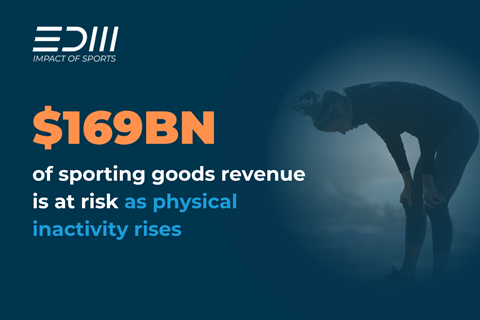
How much is movement worth? In 2026 there is, for the first time, a number. The World Economic Forum values the global sports economy at $2.3 trillion and warns that $169 billion in sporting goods revenue, roughly 27 percent, is at risk if physical inactivity keeps rising.
It is rising. Nearly a third of adults worldwide fall short of recommended activity levels, Europe’s fitness boom has barely touched them, and the WHO’s 2026 milestone will pass with its target unmet.
Our 2026 Impact of Sports special gathers the newest evidence on both sides of that ledger. FESI makes the policy case and Laureus challenges the brands, while ASICS shows what a long-term commitment to movement looks like. The industry’s largest untapped market remains the part of the world that doesn’t move yet.
For the first time, the global sports economy has a price tag. The World Economic Forum’s Sports for People and Planet Insight Report, published in January 2026 with Oliver Wyman, values it at an estimated $2.3 trillion. The sporting goods industry accounts for roughly $614 billion of that, with further growth projected.
Buried in the same report sits a less flattering calculation. Oliver Wyman’s analysts put $169 billion of projected sporting goods industry revenue at risk, about 27 percent, because physical inactivity keeps rising while climate change and the loss of natural spaces erode the environments people move in.
Why would a growing industry worry about shrinkage? Because the growth and the risk describe two different populations. Revenues climb on the back of people who already train and track their progress. The World Economic Forum, meanwhile, expects the number of physically inactive people worldwide to increase by a further 800 million by 2030 under current trends. Each of them is a customer the industry has not reached, and a cost that eventually lands in someone’s health budget.
The 2026 checkpoint
2026 is a milestone year in the WHO’ s Global Action Plan on Physical Activity. When GAPPA was adopted in 2018, member states committed to a 15 percent relative reduction in physical inactivity by 2030, with formal progress checks along the way. This year, the WHO reports against the 2026 milestone at the World Health Assembly.
The numbers going into that assessment have barely moved. Nearly a third of adults worldwide, around 1.8 billion people, fall short of recommended activity levels according to the latest WHO estimates. If nothing changes, the figure approaches three billion by 2030.
Adolescents fare worse. 81 percent of 11- to 17-year-olds are insufficiently active, and the gender gap opens early: 85 percent of girls miss the recommended levels, against 78 percent of boys.
None of this is abstract. Physical inactivity feeds directly into non-communicable diseases, which cause around three quarters of deaths worldwide, and the WHO estimates that four to five million deaths a year could be prevented if the world became more active. Active individuals carry a 20 to 30 percent lower risk of premature death than inactive ones.
Does a missed milestone matter? Politically, yes. Halfway to the 2030 deadline, governments can no longer point to plans; they have to point to results. That accountability gap is exactly where the private sector has begun positioning itself.
How does a market grow by nine percent while almost half its population never moves?
That is the question the European data poses in 2026. The Deloitte and EuropeActive European Health & Fitness Market Report 2026 counts 75.5 million fitness club members across Europe in 2025, with sector revenues up 9.1 percent year on year. Operators are optimistic and facility numbers keep expanding. In the United States, a record 81 million people now hold a membership.
However, the participation base tells a different story. The most recent EU-wide Eurobarometer found that 45 percent of Europeans never exercise or play sport, a share that has crept upward since 2009 rather than falling. Women remain less active than men across nearly every age group, and the WEF report adds a number that should give any brand with a women’s line pause: in the EU, women and girls account for just 37 percent of sports participation.
Put the two datasets side by side and a pattern emerges. The industry has become very good at serving people who are already active, selling them more coaching and better equipment. The inactive majority sits outside that loop entirely. It is the largest unaddressed market the sector has, and the reason the WFSGI’s strategy carries the blunt instruction to “move the inactive”.
Brussels sees the same gap, though it frames it differently. Ariane Gatti, Senior Communication and Policy Manager at FESI, describes sporting goods as “enablers of participation” rather than simple consumer goods, and locates the real obstacle outside sport ministries. Activity levels, in her reading, are shaped as much by transport planning, education systems, workplace policy and health prevention strategies as by sport policy itself, yet sport is still handled as a standalone policy file. FESI’s proposed answer is structural: a European Pact for Sport and Physical Activity to align member states, paired with a European Observatory on Physical Activity so that participation policies can finally be measured against results.
→ Read the full interview: Why sport is Europe’s most underutilised social policy tool
One year on from the WFSGI Sporting Goods Physical Activity Impact Report
May 2025, Geneva. The WFSGI launched the first Sporting Goods Physical Activity Impact Report at a side event of the World Health Assembly, backed by 26 member companies that together employ more than 332,000 people. The stated aim was to move the industry from advocate to accountable actor, with tracked commitments instead of campaign claims.
What has the report actually changed?
Institutionally, quite a lot. It built on the 2023 memorandum of understanding between the WFSGI and the WHO, the first agreement of its kind with a business association focused on grassroots sport. In January 2026, the WEF’s Sports for People and Planet report named the WFSGI as a bridge between industry and the global health and sustainability agenda. In May, the federation co-hosted a high-level side event at the 79th World Health Assembly together with the Commonwealth Secretariat, putting ministers and youth leaders at the same table as sporting goods executives.
A year ago, physical activity lived in the CSR annex of most annual reports. It is now discussed as core health and economic policy, and for the first time the industry holds a formal seat in that conversation.
New frontiers
Movement in the age of GLP-1. No development has reshaped the health conversation faster than the mass rollout of obesity medications. The industry line is that pharmacology and physical activity belong together rather than in competition. The WFSGI has publicly backed calls to make physical activity and nutrition central to the GLP-1 rollout, and fitness research bodies are publishing their first guidance on medicated members, who typically need resistance training to preserve muscle mass and often enter a gym for the first time in decades. A customer group that did not exist three years ago is forming, medically motivated but low in confidence.
→ Read: WFSGI and six global bodies call to embed fitness and sport into GLP-1 treatment
Active aging. ACSM’s Worldwide Fitness Trends for 2026 rank programming for older adults among the top global trends, and facility data suggests over-65s now visit more frequently than several younger segments. Europe is aging faster than any other region. What looks like a niche today is the demographic centre of the next decade’s participation growth.
Wearables. Nearly half of US adults wear a fitness tracker or smartwatch, and wearable technology tops ACSM’s 2026 trend ranking, with most users applying the data to their training decisions. For inactive people, the same technology cuts both ways. It can gamify the first step, or it can quantify failure.
Space to move. The WEF report pays unusual attention to the environments people move in. Extreme weather, degraded green space and car-first urban design suppress activity, and the effects fall hardest on groups already underrepresented in sport. Cities that invest in safe, climate-resilient public space enable participation, and the report treats that investment as an economic lever rather than a cost. SGI Europe made the same argument from the brand side last year, in Katalina Farkas’ look at why sports brands are investing in critical infrastructure; Gatti’s call for cities designed around active mobility now extends it to the policy level.
Brands moving the needle
Is the industry actually using the lever it holds? Paul Schif has his doubts. The Managing Director of Laureus Sport for Good Germany and Austria has spent twelve years in sport-for-development, and in his Impact of Sports interview with SGI Europe he calls sport “a societal engine” that most brands still treat as campaign material rather than corporate purpose. His benchmark is deliberately uncomfortable: no sporting goods company has anchored sport-for-development in its business objectives the way Patagonia anchored environmentalism, even though the commercial logic seems obvious to him. Where he does see credible movement is among challenger brands, and he singles out On’s running-focused social programmes, alongside Nike’s long involvement with Laureus in the US and the adidas foundation’s work.
Against that benchmark, the examples below were chosen for depth of commitment rather than campaign reach.
ASICS, Move Your Body, Move Your Mind
Few brands have built as durable a bridge between movement and mental health. The 2025 WFSGI report documented the lineage: Movement for Mind, an eight-week programme validated in one of the largest randomised controlled trials of its kind, and Desk Break, which turned a 15-minute movement break into a contractual right for ASICS employees. January 2026 added the consumer-facing chapter. The global Move Your Body, Move Your Mind campaign returns the brand to its founding acronym, Anima Sana In Corpore Sano, with running and tennis films set to a reimagined version of The Beach Boys’ “Good Vibrations”. Community activations in key markets are designed to let people feel the effect first-hand, and the message rests on research suggesting that even 15 minutes of exercise may lift mental state. Global marketing head Gary Raucher describes 75 years of “helping more people move so they can feel better”. The campaign earns its place in this special through continuity. ASICS ran the research first and built the marketing on top of it, which remains rare in the category.
→ Read: ASICS launches ‘Move Your Body, Move Your Mind’ campaign
Oura, a wearable aimed past the athlete
The wearables frontier already has its test case. Oura launched the Ring 5 in June with “Subtle Power”, the largest media campaign in the company’s history, and pointed it deliberately away from performance culture. The films feature teachers, artisans and orchestra conductors instead of athletes, and the out-of-home push runs in Berlin and London alongside US cities, a signal of European ambitions. Commercially, the approach is working: revenues passed $500 million in 2024, were projected to reach $1 billion in 2025, and the company’s valuation stands at roughly $10.9 billion.
Two software layers make the launch relevant to this special. Health Radar introduces continuous cardiovascular and respiratory monitoring, and GLP-1 Insights consolidates dosing, biometric and lifestyle data for users on weight-loss medications, which makes Oura one of the first consumer brands building directly for the medicated population described in section 5. Whether monitoring at this granularity can change behaviour at population scale, beyond the performance-obsessed and the already active, isn’t clear yet.
→ Read: Oura Ring 5: inside the campaign and the strategy behind it
Where does that leave the industry in mid-2026?
The factual summary is short. Inactivity has not fallen. The fitness market has grown regardless, and the WHO’s 2026 milestone will pass without its target being met. The WEF has priced the consequences of continued drift at $169 billion for this industry alone.
The sector’s biggest growth opportunity and its biggest social contribution are, for once, the same project: reaching the people who do not move yet would expand the market and relieve health systems at the same time. Schif makes the same point from the non-profit side, arguing the potential is obvious and nobody has fully claimed it. Few industries are handed that kind of alignment between commercial interest and public benefit, and this one now has the evidence base to act on it.

Impact of Sports
The global physical inactivity crisis is real. Our duty as an industry is to inspire a healthy and active lifestyle. That's why we're dedicating a new content series to the Impact of Sports.
>> Find out more.