
Fortune favors the brave. The metaverse and NFTs are here to stay, and brands would do well to jump in early, especially when it comes to preparing yourself for some of the legal issues that come with the metaverse. For beginners, we explain exactly what is the metaverse and what NFTs stand for, along with some examples of sporting goods brands that are already investing in the metaverse. If you’re already in the know, you can skip to the potential legal consequences of NFTs and the metaverse for brands and how you could begin to protect your sporting brand in the metaverse.
- The metaverse: Why all the excitement?
- What is the metaverse?
- How are businesses using the metaverse?
- IP protection and enforcement in the metaverse
- The legal difficulties and challenges of NFTs for brands
- The metaverse is coming: How should brands prepare for legal challenges?
The metaverse: Why all the excitement?
If one asked the average consumer on the street what the terms “metaverse” and “NFTs” mean, the percentage of those who could provide an accurate answer would be very small. In the sporting goods industry, the total number of those dealing intensively with these topics is also somewhat limited and is spearheaded at major brand level by Nike, Adidas, Puma, New Balance and Under Armour.
The opinion of those in the know is divided. Some say the Web 3.0 vision and concept – heavily promoted in particular by the Meta Group/Mark Zuckerberg and other Silicon Valley giants – is temporary hype; a gimmick not worth wasting time and money on. Others take this topic more seriously but still have doubts about whether sufficient concrete cases of use exist.
From a legal point of view, the metaverse and NFTs (non-fungible tokens) create more challenges and questions than answers. These questions cross all aspects of legislation – legal regulations, national case law, and regional courts.
One thing seems obvious: With communication technologies developing exponentially and with the next generation already diving deep into virtual and digital worlds, the metaverse will not disappear. Just like the internet did not disappear. And this generation will become the drivers of the future of the sports business and sporting goods in years to come.
The real question is, in which commercial and noncommercial areas will the metaverse be relevant, and how strong and widely adopted will Web 3.0 be in the next few years?

What is the metaverse?
First – at least for the time being – there is no such thing as THE metaverse. There is no single, all-encompassing virtual universe. But the common element which defines this new dimension is an immersive and constant virtual 3D world, where real people interact through an avatar.
Both centralized and decentralized metaverses exist. A prominent example of a decentralized metaverse is Decentraland, a virtual world browser-based platform where users can buy virtual plots of land as well as digital wearables in the platform as NFTs. Centralized metaverses include the gaming world, The Sandbox.
Others define the metaverse as a version of the internet that incorporates three-dimensional virtual environments or as a three-dimensional virtual world, most notably, online role-playing games.
What are Non-Fungible Tokens (NFTs)?
NFTs are unique digital certificates that are registered in a blockchain and are used to record the ownership of an asset such as an artwork or a collectible. It is, however, important to know that an NFT does not mean the digital asset itself.
The most prominent example of an NFT is the collage “Everydays: The First 5000 Days” by the digital artist, Beeple. This was auctioned as an NFT for more than 69 million USD at Christie’s in March 2021.
In the sporting goods world, NFTs have previously included sporting wearables from Adidas to be used in The Sandbox (sold with matching physical products) and digital footwear products from Asics. These digital products are usually very limited editions to increase demand.
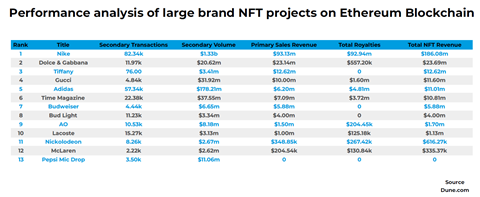
Nike is the undisputed king in the sporting goods sector when it comes to the generation of revenue from NFT-related projects. NFTs resulted in nearly $200 million income for the sporting brand Nike in 2022.
Dune Analytics provided data on the overall NFT transactions in 2022 by brands in various sectors. According to the figures, after Nike, Adidas is the fifth biggest sporting brand making money from NFTs, and the Lacoste brand is fifteenth:
How are businesses using the metaverse?
Right now, the metaverse is mainly used in the field of computer games and social media platforms, but it is gaining popularity for virtual events, such as online concerts, trade fairs, and fashion shows. It is already revolutionizing e-commerce through virtual shopping malls. In May 2022, Real Madrid set up a virtual version of its home stadium – Santiago Bernabéu – complete with a trophy case and its environs.
In healthcare, virtual therapies and surgeries are still largely science fiction, but e-learning in the field of B2B applications – such as training workers to handle new machinery equipment – is already on the horizon. Interpol has, for example, already started immersive global training for its staff and third parties in a digital metaverse environment in areas such as securing evidence at crime scenes, security controls at airports, and so on.
To describe the metaverse as a new technology is too narrow an understanding. It is a new business model. One which needs out-of-the-box thinking, new company policies, and a new legal framework. How big will the metaverse be? According to a study by the global consultancy Gartner Inc. in October 2022, it is predicted that in 2026, one out of every four people will spend at least one hour per day in the metaverse.
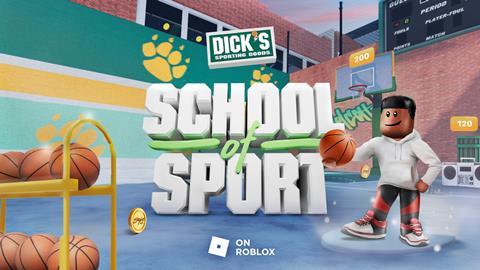
The metaverse is also used by sporting brands. There are several examples of the metaverse in the sporting goods industry. In Nov. 2021, sporting brand and digital pioneers Nike partnered with the online game platform and game creation (and storefront) app Roblox to create a metaverse, “where sport has no rules. Tag on trampolines? Why not. Floor is lava with a dash of parkour? Let’s go.” And, of course, using Roblox’s in-app purchases, avatars can be styled in Nike gear.
Timberland, a VF Corp brand, created a digital gaming experience that sends players on a journey through the brand’s past, present and future and offers them a chance to win a pair of boots.
IP protection and enforcement in the metaverse
You don’t need to be a legal expert to recognize that the use of avatars, trademarks, names, logos, music, slogans, and designs in the metaverse creates new challenges for legitimate rights holders when it comes to the protection and enforcement of their established intellectual property (IP) rights. An avatar wearing branded sneakers and sports apparel – where the person or legal entity behind the avatar has not obtained the prior approval of the rights owner – risks running into conflict over IP issues.
Is it enough for brands to rely upon the already existing legal instruments, such as traditionally registered trademark registrations (International Class 18 for footwear and IC 25 for apparel) to protect their IP in the metaverse? The answer is clear: No.
It is therefore recommended to secure additional Web 3.0-related trademark registrations in International Class 9, e.g., for downloadable virtual goods. This would cover computer programs featuring athletic footwear and clothing for use online and in online virtual worlds. If digital services are offered, Classes 35 and 41 may be the right choice.
Design protection already requires specific attention to detail and very careful wording in order to avoid the rejection of an application, even before we take the metaverse into consideration. The European Union Intellectual Property Office (EUIPO) is struggling with numerous new challenges when it comes to community design applications aimed at use in the virtual world. It has established a specific in-house Metaverse Working Group, encompassing staff from various divisions, to bring in necessary reforms in this field. Right now, there are still more questions raised than answers.

Enforcement of intellectual property rights in the metaverse constitutes another major challenge. IP owners need first to detect and identify intellectual property infringements, such as copyright and trademark violations. This will undoubtedly require the use of sophisticated artificial intelligence technology, like that offered by Corsearch: a recent cooperation partner of the WFSGI (World Federation of the Sporting Goods Industry).
According to Corsearch, more than 12.5 billion online references to brands and content are captured annually. To monitor the intellectual property of brands, they offer solutions including trademark screening, trademark searching, trademark watching, domain services, and brand and content protection.
For sporting brands, there is another potential legal problem with the metaverse. Avatars, virtual goods and services exist in a virtual universe where no geographic territories exist.
Given the transnational nature of the metaverse, questions of applicable law, jurisdiction and competent authorities are still open. This applies in particular to any legal action taken against the typical anonymous user of the metaverse, who is “hiding” behind an avatar.
Whether legal action is to be directed against the metaverse provider or against users of avatars is still unclear. For now, we have to wait and see how authorities such as the European Commission and national and regional courts will deal with these topics.
The legal difficulties and challenges of NFTs for brands
NFTs are mostly used by applying blockchain technology to create unique digital tokens. These serve as a binding element between the virtual and the real world. They certify the authenticity of the transaction but nothing more, and these so-called smart contracts are not contracts in the traditional sense.
Smart contracts are just programs stored on a blockchain, provided certain predetermined conditions are met. They completely automate the conclusion of an agreement to ensure that all involved parties can be immediately certain of the outcome in real-time, without the involvement of an intermediary.
In addition, they may automate the workflow of an operation, triggering a subsequent action if certain conditions are fulfilled.
Being brand new, smart contracts are, for the most part, not yet covered by any specific legal regulations. Again, they raise many more questions than answers when it comes to trademark and copyright protection, but also general civil law and contractual issues.
Legal difficulties with NFTs may include:
- The involvement of an avatar rather than a real individual
- Breaches of agreement
- Wrong perceptions of what has been purchased
- Or even criminal law issues like fraudulent actions.
In the U.S., the first court actions relating to NFTs have begun to pop up, where purchasers of allegedly valuable artwork have realized that they purchase worthless copies from payments involving considerable amounts of money.
Data protection and cybersecurity are two other topics that could become very hotly discussed in the Web 3.0 universe.

The metaverse is coming: How should brands prepare for legal challenges?
A number of sizable brands and retailers in the sporting goods sector openly regret neglecting the internet in its early days or becoming active too late. This could also happen with the metaverse and NFTs. The sporting goods industry – and in particular smaller to medium-sized enterprises – would be well advised to not just passively follow the developments in this area but to become proactive.
-
Review existing trademarks and design patent portfolios, and register additional, specific metaverse-related IP rights at national and international levels as a first step.
-
Look to see whether technical tools and service providers could be helpful to identify and prosecute IP infringements in the metaverse.
-
To protect their IP in the metaverse, sporting goods brands should ask whether it could be of commercial interest to create their own digital assets for protected products on a blockchain basis.
When it comes to the legal problems of the metaverse and solutions for the sporting industry, Albert Einstein may have said it best: “Problems cannot be resolved with the same mindset they have been created.” In other words, these new issues require new innovative and creative thinking and solutions. Like the metaverse itself, we’re only at the beginning of this process.
Dr. Jochen M. Schaefer is a German practicing attorney based in the Munich area. For several years, he has been representing the World Federation of the Sporting Goods Industry (WFSGI) and the European Federation of the Sporting Goods Industry (FESI) as their legal counsel. He also chairs the WFSGI’s legal committee and is co-chair of the FESI’s digital working group. At the individual client level, he represents a significant number of well-known brands within and beyond the bicycle/sporting goods sector. He is a specialist in national and international distribution topics, intellectual property (IP) and risk management issues, and the drafting and negotiation of comprehensive contracts at the operational level; in particular in the area of European selective distribution schemes. In case of any questions about this article (or in general), he can be reached at sj@sjlegal.de and at +49 151 1640 7932.